
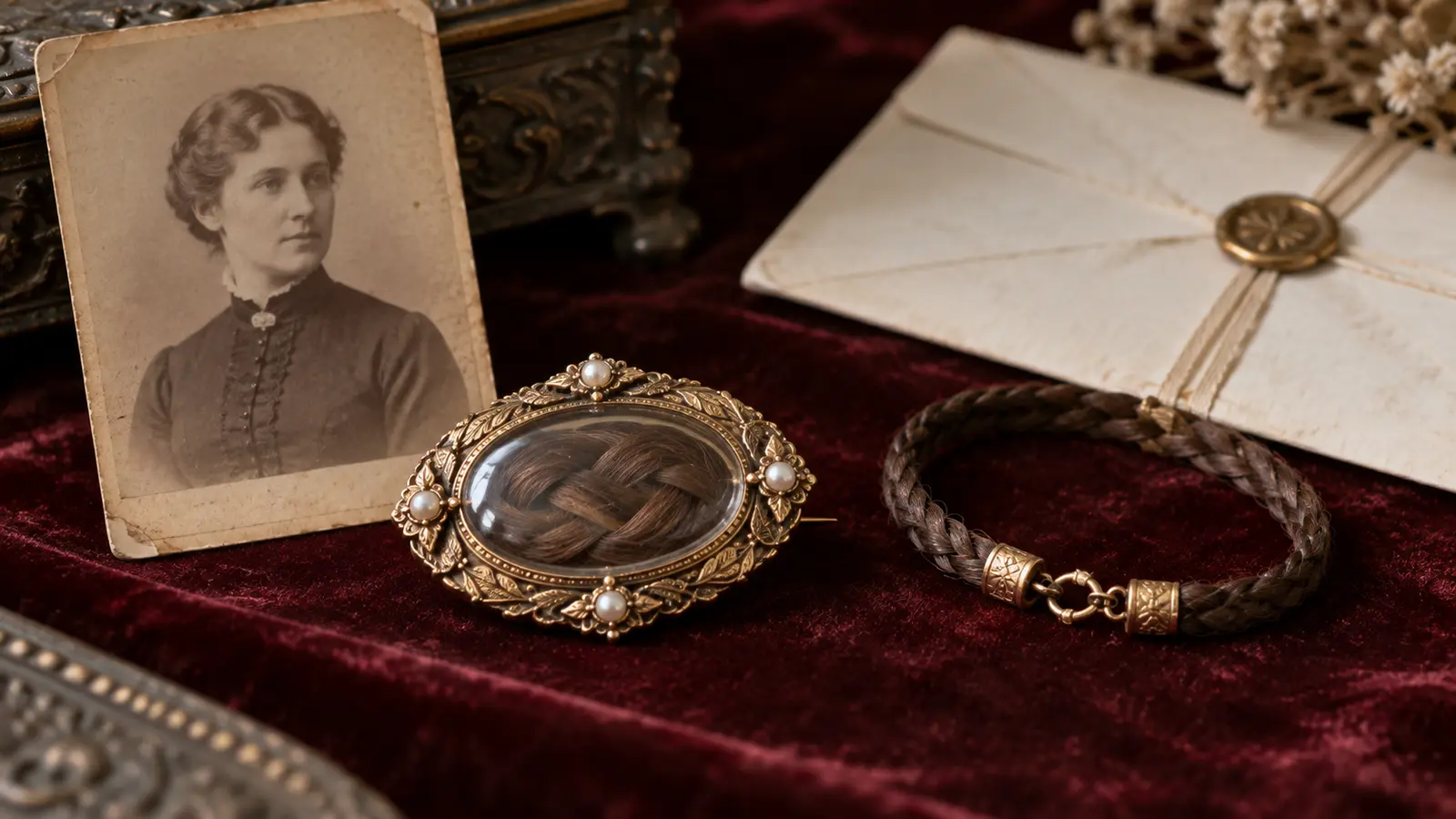
Why did Victorians make jewellery from human hair? Hair was a durable, intimate piece of a person that could be kept close after separation or death. Woven into bracelets, watch chains and rings, or sealed beneath glass in a brooch, it turned memory into something physical and wearable.
To modern eyes, the practice can look gothic or macabre. To many people in the nineteenth century, however, a lock of hair was an affectionate relic. Hair jewellery belonged to a larger culture of sentimental objects, formal mourning and handmade domestic craft.
The Victorians did not invent keeping hair
People exchanged and preserved hair long before Queen Victoria came to the throne in 1837. Earlier mourning rings and lockets could contain hair, names, dates and symbols of mortality. What changed in the nineteenth century was the scale, variety and visibility of the practice.
Romantic ideas about feeling and remembrance made personal keepsakes especially meaningful. At the same time, expanding consumer markets offered specialised fittings, pattern books and professional services. A custom once limited to a simple lock could become an elaborate piece of jewellery or a framed family wreath.
Hair seemed to preserve a real connection
Hair has practical advantages as a keepsake. It is tough, flexible and slow to decay when kept dry. It does not rapidly lose its familiar colour and texture in the way flowers fade. Most importantly, it came directly from the person being remembered.
A portrait showed someone’s appearance, but hair was part of their body. That gave it the emotional force of a relic without requiring the display of anything conventionally gruesome. A small plait behind glass could be private enough for the wearer, while an inscription told future viewers whose memory it carried.
Mourning jewellery often included black enamel, gold, pearls, initials or a date of death. Locks of hair might sit in a compartment at the back of a pendant or form part of a decorative scene. The object expressed grief, but also social duties: wearing it could show continuing attachment and participation in accepted mourning customs.
Not every hair bracelet marked a death
Hairwork was also made for the living. Sweethearts exchanged it during courtship or separation. Friends gave locks as tokens of affection. Parents kept children’s hair, and family members combined strands in wreaths that worked like three-dimensional family trees.
That wider use matters because “mourning jewellery” can become an easy label for any old object containing hair. Without an inscription, provenance or clearly funerary design, a piece may have commemorated friendship, travel or family continuity rather than bereavement.
How hair became jewellery
Some pieces were assembled at home, an intricate parlour craft compared by the Smithsonian to knitting or crochet. Cleaned hair could be sorted into bundles and plaited, looped or woven around forms. Wire helped shape flowers and leaves for wreaths, while jewellers supplied clasps, mounts and metal settings.
Table-work hair weaving used weighted strands arranged around a central opening in a work table. Different movements produced hollow cords, flat bands and patterned braids suitable for bracelets, necklaces and watch chains. Other makers created tiny curls and motifs beneath glass, sometimes called palette work.
The craft was commercial as well as domestic. Customers could send hair to workshops or order fashionable designs. That created an obvious problem of trust: how could someone know that the returned piece contained the right person’s hair? Period anxieties about substitution helped make home production emotionally attractive even when professional metalwork was added later.
Why the custom later began to look creepy
Sentimental conventions change. Photography offered another affordable way to preserve a likeness, mourning customs became less elaborate and mass-produced fashion moved on. Objects that had once communicated tenderness began to look excessively intimate or old-fashioned to later generations.
The same shift happens with many ordinary historical objects. Old houses had boot scrapers because muddy streets made them practical, while Victorian streets needed horse troughs because living transport required water. Remove the surrounding habits and the surviving object can seem peculiar.
Hair jewellery deserves the same context. Its material is startling today, but its purpose was familiar: keeping someone close, signalling a relationship and giving memory a durable form.
Bottom Line
Victorians made jewellery from human hair because hair endured and carried an unusually direct connection to its owner. It could memorialise the dead, but it also celebrated affection among living friends, partners and relatives. Home hairwork, professional jewellery making and a thriving sentimental market turned private locks into rings, brooches, chains, bracelets and family displays.
FAQ
Was all Victorian hair jewellery made for mourning?
No. Hair was also exchanged as a token of friendship, courtship, family affection or separation. The design and documentation matter when identifying an object.
Did people make hair jewellery at home?
Yes. Hairwork was practised as a domestic craft, although jewellers and specialist workshops also made pieces and supplied metal fittings.
Why did hair last so well?
Hair is rich in tough keratin fibres. When kept dry and protected, it can retain its structure, colour and personal association for a very long time.
Further Reading
- Why Did Old Houses Have Boot Scrapers?
- Why Did Victorian Streets Have Horse Troughs?
- Why Were Old Books Chained to Shelves?
Sources
London Museum — Objects of love & loss: Mourning jewellery :: https://www.londonmuseum.org.uk/blog/mourning-jewellery-love-loss/
Smithsonian Libraries and Archives — Fashion for Hair: A creepiness I like :: https://blog.library.si.edu/blog/2014/06/25/fashion-for-hair-a-creepiness-i-like/
National Museum of American History — Gold Ring (hair jewellery) :: https://americanhistory.si.edu/collections/object/nmah_355729