
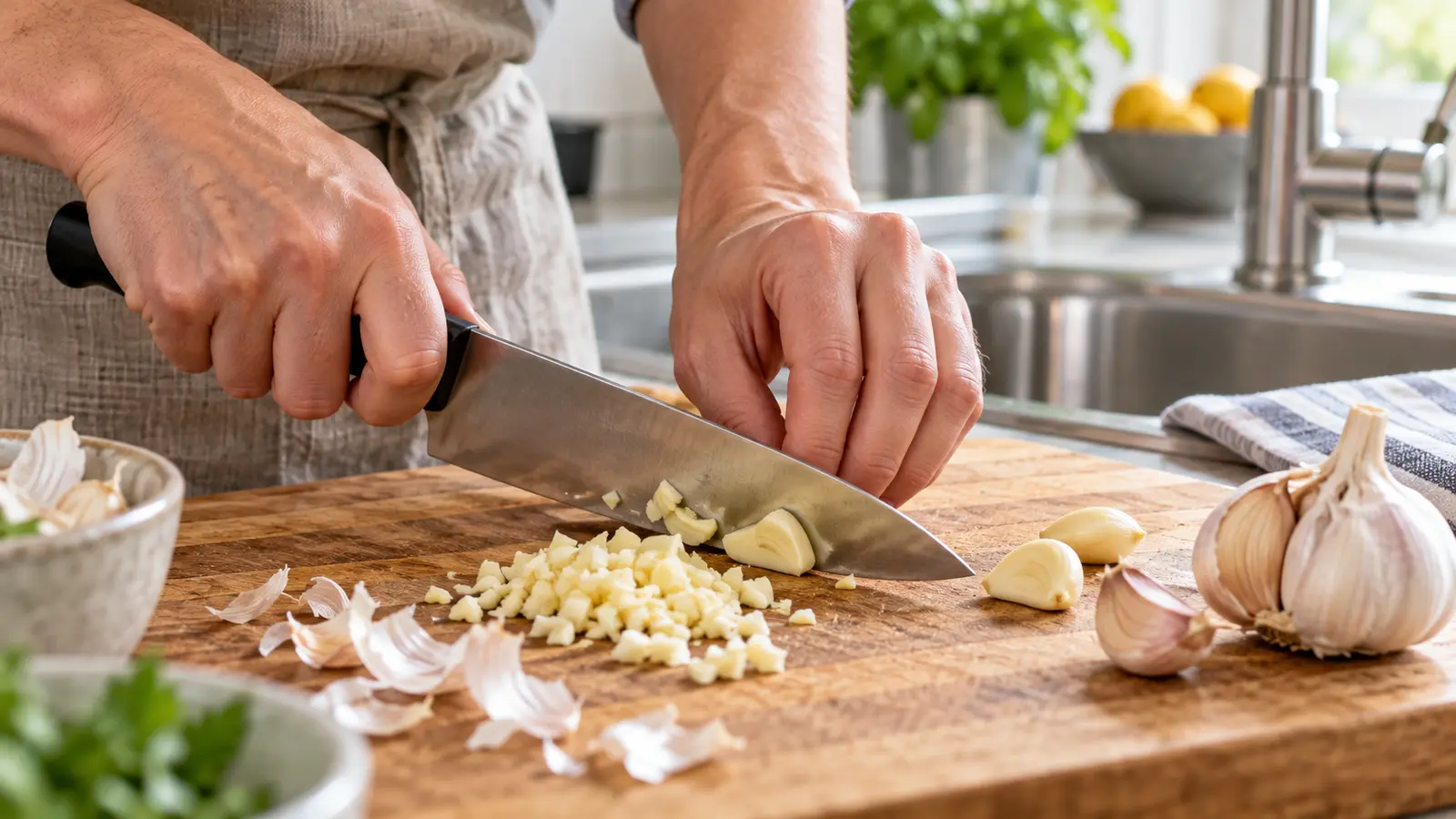
Why does garlic smell stay on your hands? Crushing garlic creates a mixture of pungent sulfur-containing molecules. Some are volatile enough to reach your nose easily, while others spread through skin oils and collect around fingerprints, nails and tiny creases where a quick rinse does not remove them.
The smell is not sitting on the clove waiting to escape. Much of garlic’s characteristic chemistry is assembled when its cells are damaged, which is why an intact bulb smells far milder than garlic that has been chopped, grated or crushed.
Cutting garlic activates its chemical defence
Inside an undamaged clove, the precursor alliin is kept apart from an enzyme called alliinase. A knife or garlic press breaks the cellular compartments and brings them together. The reaction rapidly produces allicin, a sulfur-containing thiosulfinate responsible for much of the sharp aroma and taste of freshly cut garlic.
Allicin is reactive and unstable. It can break down and rearrange into other organosulfur compounds, including diallyl sulfides and related molecules. The exact bouquet changes with time, heat and preparation, which helps explain why raw crushed garlic, gently cooked garlic and deeply browned garlic smell so different.
It is another example of kitchen damage triggering chemistry, much like the reaction that makes onions bring tears when their cells are cut. Garlic’s products target the nose rather than the eyes, but both plants manufacture potent compounds after tissue is broken.
Why water alone is disappointing
Your hands are covered by a thin mixture of natural oils, dead skin cells and microscopic texture. Garlic juice spreads across that surface as you hold and chop the clove. Sulfur compounds and small pieces of garlic can remain in the oily film, beneath nails and beside cuticles.
A brief rinse removes water-soluble material and loose debris, but water does not lift oils particularly well. Because human smell is very sensitive to many sulfur compounds, a tiny residue can remain obvious long after the hands look clean. Warm hands also encourage volatile molecules to enter the air, making the remaining trace easier to notice.
Soap is the sensible first choice
Ordinary soap or washing-up liquid contains surfactants. These molecules help water surround oily material and carry it away. Lather the palms, backs of the hands, fingertips, between the fingers and around the nails, then rinse thoroughly. A soft nail brush can remove trapped fragments, but aggressive scrubbing can irritate the skin and create more places for residue to cling.
If one wash leaves a smell, repeat it rather than reaching immediately for a harsh chemical. Cleaning the knife, board and sink matters too: touching a contaminated handle after washing can put the odour straight back.
Do lemon, bicarbonate and stainless steel work?
Lemon juice may change or mask the aroma and can help loosen some residues, but acid can sting cuts and irritate dry skin. Bicarbonate of soda adds mild abrasion and changes pH, yet a gritty paste can also be drying. Neither is necessary if soap and careful cleaning do the job.
Rubbing hands on stainless steel under running water is a famous kitchen tip. A chemical interaction between metal surfaces and sulfur compounds is plausible, but strong controlled evidence for the household trick is limited. The running water and rubbing may account for part of the result. It is harmless to try on smooth, clean steel, but it should not be treated as a scientifically settled neutralisation method.
Odour-removing products often work by some combination of surfactants, absorbent material, fragrance and mechanical rubbing. The useful question is not whether something has a dramatic reaction with “garlic”, but whether it safely removes the oily residue and trapped plant material from skin.
Prevention is easier than deodorising
Use a fork, food processor or garlic press if you want less contact, or wear food-safe gloves for a large batch. Wash soon after preparation, before the residue is spread to taps and cupboard handles. A little cooking oil on the hands is sometimes suggested, but adding more oil can distribute the compounds unless it is followed by a thorough detergent wash.
Garlic is not the only food whose molecules fool or overwhelm the senses. Capsaicin activates heat-sensitive receptors, which is why spicy food feels hot when it is not, while enzymes and oxidation explain the browning of bananas. The kitchen is a chemistry lab with better snacks.
Bottom Line
Garlic odour lingers because chopping produces allicin and a changing family of pungent sulfur compounds that spread through skin oils and lodge in fine creases. Water alone leaves some of that film behind. Soap or washing-up liquid, careful rubbing and cleaning around the nails are the most dependable approach; lemon, bicarbonate and stainless steel are optional helpers with caveats, not magic erasers.
FAQ
Why does crushed garlic smell stronger than a whole clove?
Damage lets the enzyme alliinase meet its precursor alliin, rapidly forming pungent allicin and then other sulfur compounds.
Is the stainless-steel trick proven?
There are plausible chemical explanations, but good controlled evidence for rubbing hands on stainless steel is limited. Soap and thorough washing have a clearer mechanism.
Can lemon juice harm your hands?
It can sting small cuts and irritate sensitive or dry skin. Rinse it off, avoid broken skin and stop if irritation develops.
Further Reading
Sources
Borlinghaus et al. — Allicin: Chemistry and Biological Properties :: https://pmc.ncbi.nlm.nih.gov/articles/PMC6271412/
Borlinghaus et al. — Allicin, the Odor of Freshly Crushed Garlic: A Review of Recent Progress :: https://pmc.ncbi.nlm.nih.gov/articles/PMC8001868/
Shang et al. — Bioactive Compounds and Biological Functions of Garlic :: https://pmc.ncbi.nlm.nih.gov/articles/PMC6678835/