
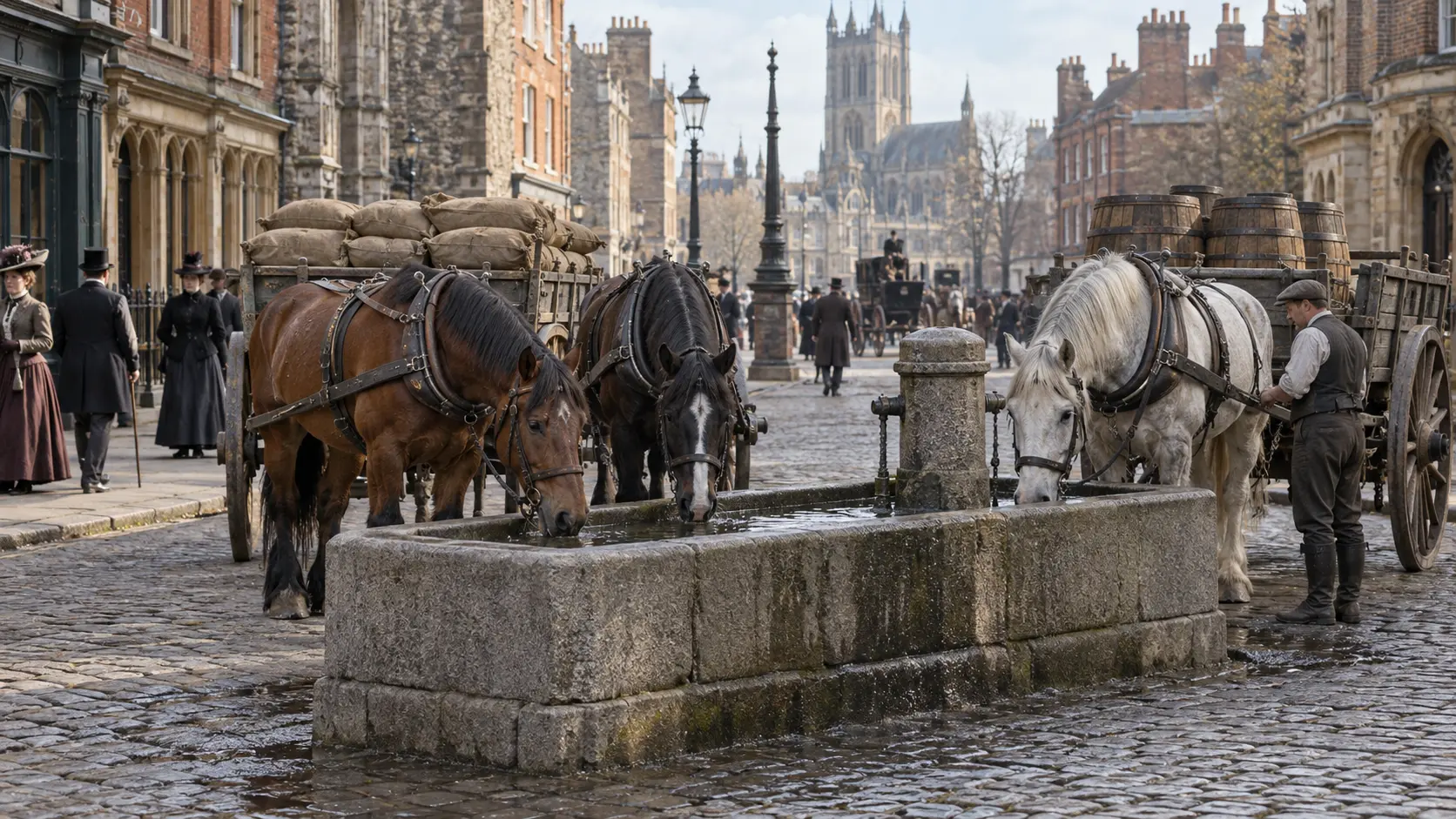
Why Did Victorian Streets Have Horse Troughs? Because urban transport ran on living engines. Horses pulled cabs, buses, delivery carts, fire engines, brewery drays, and countless loads of goods, and every one of those animals needed regular access to water.
Public troughs provided free drinking water at busy roads, markets, cab stands, and stopping points. Many were installed by charities concerned with both public water access and animal welfare. The granite containers that survive today are the service stations of a horse-powered city.
Horses Kept the City Moving
Before motor vehicles took over, almost every part of urban life depended on horses. They moved people to work, carried food to shops, hauled building materials, collected refuse, and transported goods between railway stations, warehouses, docks, and homes.
Working animals might spend long hours on the road while pulling heavy loads. Water was essential, but reliable public supplies were limited. Drivers could sometimes pay for water at inns or yards, yet free, conveniently placed troughs made care far easier.
Cattle and sheep driven to urban markets also needed water after long journeys, which is why many historic records describe cattle troughs as well as horse troughs.
A Drinking-Fountain Charity Took Up the Cause
The Metropolitan Free Drinking Fountain Association was founded in London in 1859 to provide clean drinking water for people. In 1867, its name changed to the Metropolitan Drinking Fountain and Cattle Trough Association as animal watering became a major part of its work.
The organisation installed troughs across London and beyond, often using donations and memorial gifts. The RSPCA supported the effort, reflecting growing Victorian concern about the treatment of working animals.
Many troughs carried the Association’s name and short inscriptions such as “The merciful man is merciful to his beast”. They combined infrastructure, charity, moral messaging, and extremely solid stonework.
Why the Troughs Were Made of Granite
A street trough needed to survive hooves, cart wheels, frost, rain, dirt, and constant use. Granite was durable, difficult to overturn, and relatively easy to clean. Its enormous weight was a feature once it reached the intended location, though presumably less charming during installation.
Typical troughs were long enough for several animals to drink. Some included a lower bowl for dogs, while nearby fountains supplied water for people.
A ballcock or piped supply could keep the trough filled. Drainage and cleaning mattered because standing water collected dirt from muzzles and the street.
They Were Part of Animal-Welfare Reform
Victorian Britain saw organised campaigns against cruelty to animals alongside broader improvements in sanitation and public health. Providing water was a practical intervention: it reduced suffering without depending entirely on every owner finding a private supply.
Historic England describes surviving troughs as reminders of both the vanished role of animals in city life and changing attitudes to animal welfare during the later nineteenth century.
The provision was never perfect. Horses still faced overwork, injury, heat, poor road surfaces, and harsh treatment. A drinking trough did not solve those problems, but it met one unavoidable need.
Where Troughs Were Placed
Useful sites included markets, major junctions, cab ranks, railway approaches, parks, and routes used by freight traffic. The ideal position offered access without blocking the road or forcing a heavy cart into an awkward turn.
Some troughs were funded as memorials and placed prominently in a village or town centre. Others were utilitarian pieces of transport infrastructure that became landmarks simply because they remained in place for decades.
Drivers could use stops as part of a working route, much as modern drivers plan fuel or charging breaks. The comparison is not exact—the fuel was food—but water stations were vital to keeping the network moving.
Why So Many Survive
Motor buses, lorries, vans, and cars steadily replaced working horses during the early twentieth century. Troughs lost their original purpose, but granite is stubborn. Removing a massive stone block required effort, while leaving it in place cost very little.
Some were converted into planters, moved into parks, or reused as decorative features. Others became listed structures because of their historic interest and connection to animal welfare.
Modern pedestrians can pass one daily without realising that it once served dozens of thirsty animals in the middle of ordinary traffic.
The Bottom Line
Victorian streets had horse troughs because cities depended on working animals for transport and deliveries. Charities installed free water supplies at busy locations, combining practical infrastructure with growing concern for animal welfare. The surviving stone troughs mark where a living transport network once stopped for a drink.
FAQ
Who paid for Victorian horse troughs?
Many were installed by charities, especially the Metropolitan Drinking Fountain and Cattle Trough Association, using donations and memorial gifts. Local bodies and private benefactors also contributed.
Did people drink from the same troughs?
Usually the large basin was intended for horses or cattle. Some installations paired it with a separate drinking fountain for people and a lower bowl for dogs.
Why are old horse troughs now full of flowers?
Once motor vehicles replaced working horses, many durable stone troughs were reused as planters rather than removed.
Sources
Horse and cattle drinking trough — Historic England :: https://historicengland.org.uk/listing/the-list/list-entry/1464574
Drinking Trough — Historic England :: https://historicengland.org.uk/listing/the-list/list-entry/1410037
Cattle Trough, Queen’s Avenue — Historic England :: https://historicengland.org.uk/education/schools-resources/educational-images/cattle-trough-queens-avenue-hornsey-greater-london-ioe01-01038-16