
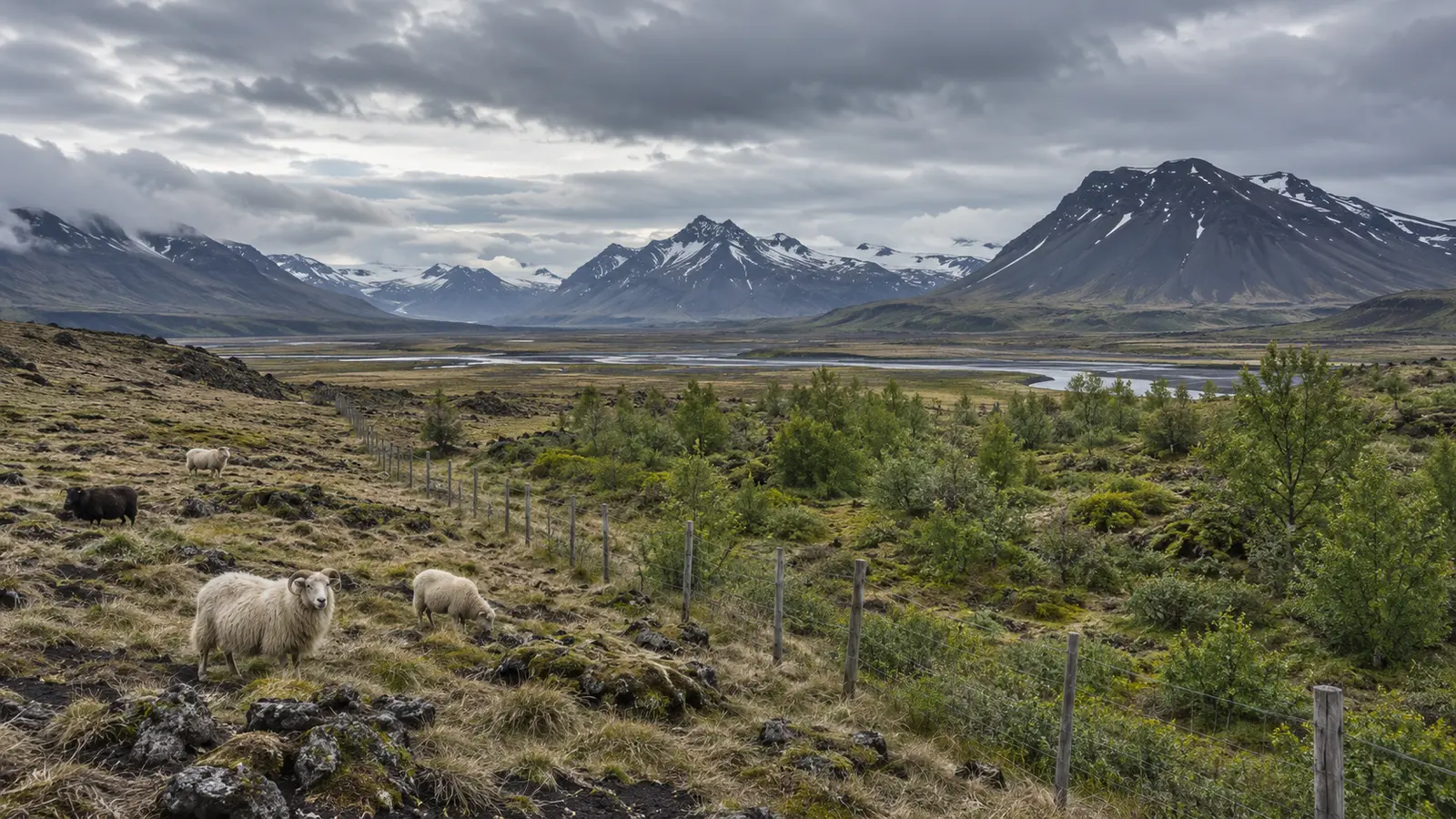
Why does Iceland have so few trees? The island once had extensive birch woodland, but settlers cleared land and used wood while livestock repeatedly ate new growth. Cold, wind, volcanic disturbance and severe soil erosion then made recovery difficult, turning a human impact into a landscape that can look naturally treeless.
Iceland is harsh for forests, but it is not uniformly beyond the tree line. Trees grow in sheltered valleys, towns and protected plantations today. The interesting question is therefore not why no tree can survive, but why woodland disappeared and failed to return across so much suitable lowland.
Iceland had woods when people arrived
The Icelandic Forest Service estimates that birch forest and woodland covered about 25–40% of the country at settlement roughly 1,150 years ago. Downy birch was the main forest-forming species, with willow scrub and smaller amounts of rowan and aspen. Exposed coasts, wetlands, uplands and the volcanic interior were never a continuous tall forest.
That starting point matters. The popular picture of Vikings arriving on an entirely bare island is wrong, but so is the image of dense woodland covering every glacier and lava field. Much of the habitable lowland carried birch woodland or scrub that was modest in height but ecologically important.
Settlers needed fields, pasture, fuel and charcoal
Norse settlers cut and burned woodland to create farms and grazing land. Timber and branches supplied building material, household fuel and fodder. Charcoal was especially valuable because it was needed for ironworking and tool production before imported steel became readily available.
Cutting alone did not guarantee permanent deforestation. Birch can regrow from seed and from surviving stems. The crucial problem was what happened afterwards: sheep, cattle, horses and sometimes pigs grazed the cleared landscape and browsed young shoots.
Sheep stopped the comeback
Repeated grazing removes seedlings before they can grow beyond an animal’s reach. It also favours grassland over shrubs and trees. A woodland harvested once can recover; a woodland harvested and then continuously browsed may remain open for centuries.
The Icelandic Forest Service identifies grazing-driven regeneration failure as the principal cause of the long-term loss. Surviving birch stands became scarce and valuable, while continuing demand for fuel and fodder placed additional pressure on them. Modern forestry initially focused heavily on fencing remnants to exclude sheep, and protection from browsing is still fundamental to many restoration projects.
Fragile soil made the damage harder to reverse
Icelandic soils receive frequent additions of volcanic ash. They can support productive vegetation, but once plant cover is broken they are vulnerable to wind and water erosion. Loss of woodland and heavy grazing exposed the surface; erosion could then strip soil, spread sand and leave conditions in which seedlings struggled to establish.
This creates a reinforcing cycle. Fewer plants mean less shelter and fewer roots holding the ground. More exposed soil means harsher conditions for the next generation of plants. In badly degraded places, simply removing sheep is not enough: the site may need stabilisation, fertilisation, seeding or carefully chosen pioneer species before woodland can return.
Climate and volcanoes contributed, but did not do it alone
Iceland sits near the climatic limit for trees. Cool summers, strong winds, salt exposure and short growing seasons keep trees smaller and make establishment slow. The colder Little Ice Age probably lowered the tree line, while eruptions, ash falls and glacial floods damaged vegetation locally.
Yet those forces cannot explain the permanent loss of most lowland woodland. Birch persisted in protected pockets throughout the same climate, and forests expand when grazing is excluded. The island’s weather made the ecosystem vulnerable and its recovery slow; human land use supplied the sustained pressure.
Cold has other unexpected effects too, from the way penguins huddle to the chemistry that makes phone batteries fade faster. For Icelandic birch, the issue is not one frosty day but the cumulative difficulty of establishing above ground that has lost shelter and soil.
Iceland is growing forests again
Organised forestry began around the turn of the twentieth century. Early work protected native birch remnants; later programmes planted both native woodland and introduced species selected for timber, shelter and land reclamation. Natural birch regeneration can be remarkably effective once grazing pressure is removed and seed sources remain nearby.
Restoration involves choices rather than a simple instruction to cover the island with trees. Native birch woodland supports local biodiversity and reconnects remnants. Mixed or introduced forests may produce timber, store carbon and shelter farms. Planners must also consider peatlands, open habitats, archaeology, landscape character and whether a species suits future conditions.
The result will not recreate the ninth century exactly. It can, however, reverse part of a millennium-long decline and make damaged land more resilient.
Bottom Line
Iceland has few trees because an initially wooded but vulnerable landscape was cleared for farming, fuel and charcoal, then prevented from regenerating by centuries of grazing. Cold, wind, volcanic events and erosion magnified the damage, but they were not the sole cause. Protection from livestock, soil restoration, natural birch recovery and careful planting are now bringing woodland back.
FAQ
Was Iceland covered in forest before the Vikings?
Not completely. Estimates suggest birch forest and woodland covered roughly 25–40% of the land, mainly in lower and more sheltered areas.
Can trees grow in Iceland today?
Yes. Native birch and several planted species grow successfully, especially where sites are sheltered, soils are stable and grazing is controlled.
Did Vikings cut down every tree?
No. Clearing began with settlement, but forest decline continued for centuries through repeated harvesting, fuel use and grazing that prevented regrowth.
Further Reading
Sources
Icelandic Forest Service — History of forests in Iceland :: https://skogur-is.manjaro.stefna.is/en/forestry/forestry-in-a-treeless-land/history-of-forests-in-iceland
Icelandic Forest Service — Forestry in Iceland :: https://skogur-is.manjaro.stefna.is/en/forestry/forestry-in-a-treeless-land/forestry-in-iceland
Arnalds et al. — A framework model for current land condition in Iceland :: https://pmc.ncbi.nlm.nih.gov/articles/PMC10325058/