
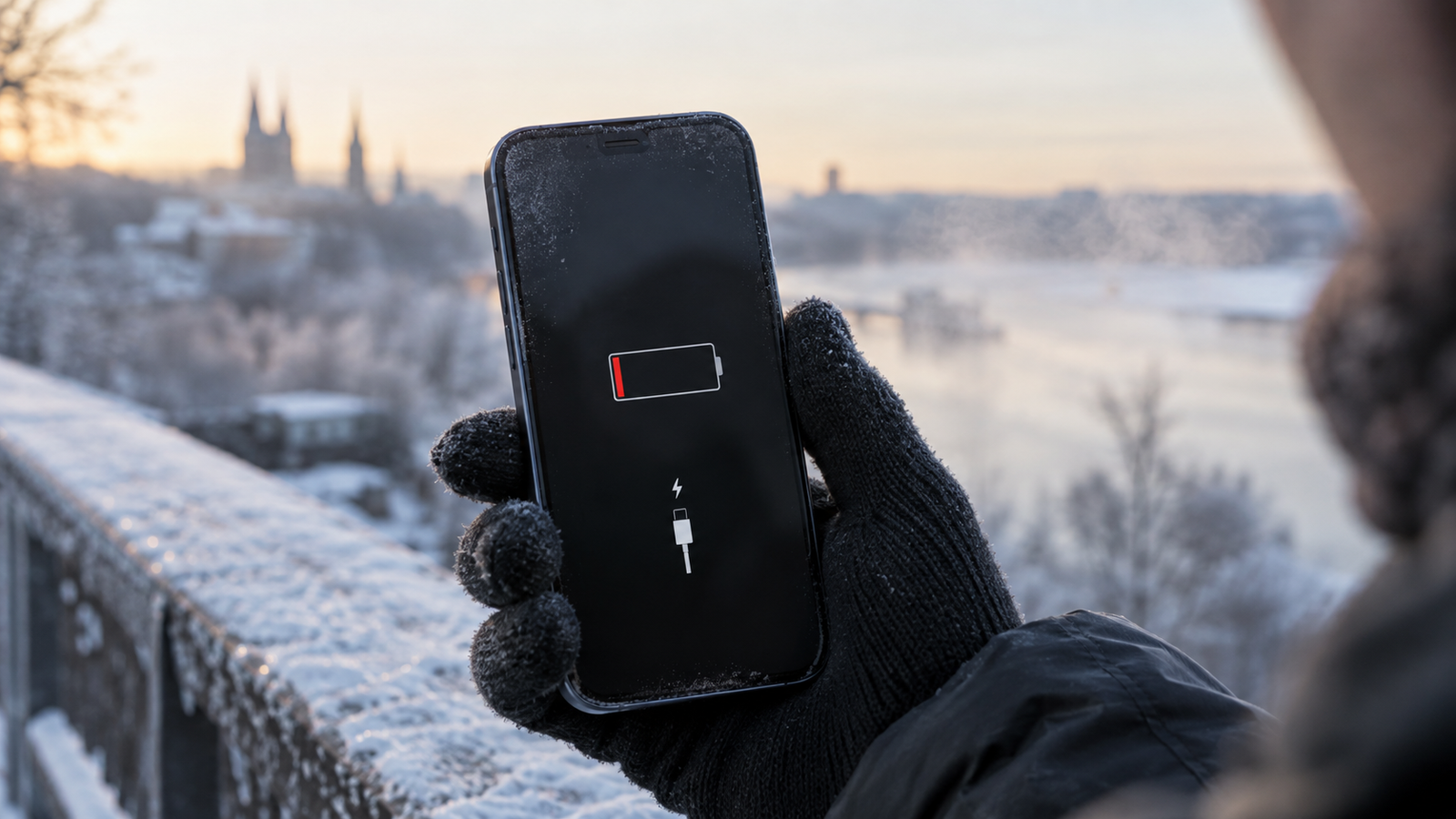
You leave the house with 60% battery. You spend half an hour outside on a freezing day, check your phone again, and somehow it is behaving as though you have been streaming video since breakfast.
Sometimes it may even shut down while claiming it still has charge left.
It feels as though the cold has simply sucked electricity out of the battery.
That is not quite what is happening.
Cold weather temporarily changes the chemistry inside the lithium-ion battery, making it harder for the battery to deliver the power your phone needs.
The charge may still be there. Your phone just cannot get at it as easily.
Why Cold Weather Bothers Lithium-Ion Batteries
Modern smartphones almost universally rely on lithium-ion batteries.
Inside one, electrically charged lithium ions move between different parts of the battery as it charges and discharges. That movement depends on chemical reactions, and chemical reactions generally slow down as temperatures fall.
The colder the battery becomes, the harder it is for it to deliver electricity quickly.
Its internal resistance — usually described more precisely as impedance — increases.
Your phone has not suddenly become dramatically more power-hungry. The battery has simply become worse at supplying that power.
Why Your Battery Percentage Can Suddenly Plummet
Battery percentage is not a tiny fuel gauge physically measuring how much electricity remains inside.
It is an estimate.
Your phone calculates the remaining charge using information such as battery voltage, current usage, temperature, and the known behaviour of the battery.
Cold temperatures can cause the battery voltage to drop more sharply when the phone demands power.
That can make the software conclude that the usable charge is running out faster than expected.
It is why a phone might fall from 30% to 15% surprisingly quickly outdoors — and then appear to regain some charge once it warms up.
Why Phones Sometimes Shut Down in the Cold
There is a minimum voltage below which your phone’s electronics cannot operate reliably.
In cold conditions, the battery voltage can dip below that level when the phone suddenly demands a lot of power.
Opening the camera, playing a game, using navigation, or turning the screen brightness up can all increase the load.
If the battery cannot provide enough voltage, the phone may shut itself down to protect its components.
Apple specifically notes that increased battery impedance in cold conditions can contribute to unexpected shutdowns, particularly when a battery is already at a low charge or has chemically aged.
Older Batteries Usually Suffer More
A brand-new battery and a five-year-old battery do not react exactly the same way.
Rechargeable batteries gradually deteriorate through normal chemical ageing.
As they age, their maximum capacity falls and their ability to provide sudden bursts of power can decline.
Cold temperatures temporarily increase impedance too, so an older battery can effectively get hit twice.
That explains why the phone that seemed perfectly happy through several winters can suddenly start throwing tantrums on the fourth.
Does the Cold Permanently Damage Your Battery?
Usually, brief exposure to ordinary winter temperatures causes a temporary loss of performance rather than permanent capacity damage.
Apple says that reduced battery life experienced while using its devices in very cold conditions should return to normal once the battery temperature rises again.
Extreme heat is generally the bigger long-term enemy of lithium-ion batteries.
So sticking your freezing phone directly onto a radiator is not the clever workaround it might appear to be.
Letting it warm naturally indoors is considerably kinder.
Why Keeping Your Phone in a Pocket Helps
Your body is effectively a free battery warmer.
A phone carried in an inside coat pocket will usually stay considerably warmer than one sitting in an external bag pocket or exposed on a car dashboard.
The difference does not need to be dramatic.
Keeping the battery a little closer to normal operating temperature helps its chemistry behave more efficiently.
The Bottom Line
Cold weather usually does not magically delete your phone’s charge.
Instead, low temperatures make the lithium-ion battery less able to deliver power. Its voltage can fall more sharply under load, your battery percentage estimate can tumble, and the phone may even shut down despite apparently having charge remaining.
Once the battery warms up, much of that temporary performance loss can disappear.
So yes, your phone genuinely hates the cold.
It is just being slightly more complicated about it than you thought.
FAQ
Why does my phone battery drain faster when it is cold?
Cold temperatures slow the chemical processes inside lithium-ion batteries and increase their internal impedance, making it harder for them to supply power efficiently.
Can a phone regain battery percentage when it warms up?
Yes. Because cold-related performance loss can be temporary, a phone may show more usable charge once the battery returns to a normal temperature.
Can cold weather permanently damage a phone battery?
Normal short-term exposure to winter weather generally causes temporary performance problems. Extreme temperatures and prolonged exposure can be more harmful.
Should I heat a cold phone quickly?
No. Allowing it to warm naturally is preferable to putting it directly against a strong heat source.
Sources
iPhone battery and performance — Apple Support :: Apple Support
Batteries – Maximising Performance — Apple :: Apple Batteries