
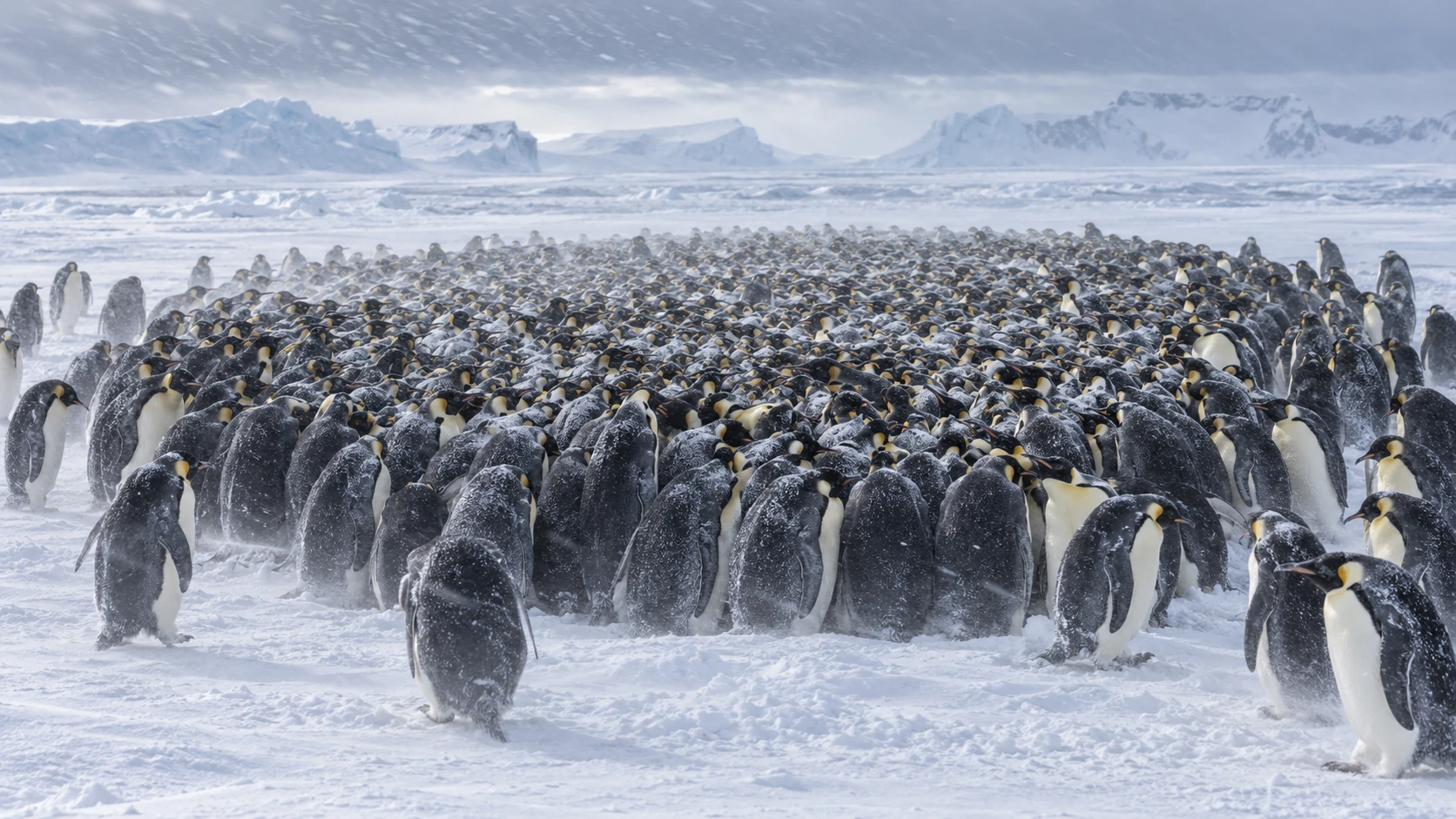
Why Do Penguins Huddle Together in those enormous, tightly packed groups seen in Antarctic documentaries? For emperor penguins, the answer is brutally practical: huddling reduces heat loss and saves energy during one of the harshest breeding seasons on Earth.
But the famous huddle is not simply a solid circle with lucky penguins in the warm middle and unlucky ones permanently stuck outside. Research has shown that emperor penguin huddles are dynamic. Birds make tiny coordinated steps, the group slowly reorganises, and individuals change position over time. What looks from a distance like a stationary black-and-white blob is actually a remarkably mobile system for surviving cold and wind.
Emperor Penguins Have an Extreme Winter Problem
The classic penguin huddle belongs especially to emperor penguins. They breed during the Antarctic winter, when temperatures can fall far below freezing and strong winds make heat loss even more severe.
During incubation, males can spend months fasting while balancing an egg on their feet beneath a fold of skin. Every unit of energy matters. Producing body heat is expensive, so reducing the amount that escapes into the environment can make a major difference.
Huddling helps by reducing how much body surface is directly exposed to cold air and wind. Birds in the interior are surrounded by other warm bodies rather than open Antarctic air.
A Huddle Creates Its Own Microclimate
Measurements cited in penguin-huddling research show just how dramatic the difference can become. Temperatures inside dense emperor penguin huddles can rise above freezing and, in some observations, much higher than that, even while the outside air remains bitterly cold.
The benefit is not simply that hundreds of penguins somehow “heat the room”. Packing tightly also shields individuals from wind and reduces exposed surface area. Models of huddle behaviour consistently show that birds on the exposed perimeter lose more heat than birds protected inside.
That creates an obvious problem, though. If everybody wants the sheltered middle, how does a densely packed crowd avoid becoming stuck?
The Penguins Move in Tiny Waves
A 2011 study used time-lapse photography to track emperor penguins in a huddle near Antarctica’s Neumayer research station. The researchers found that the birds were packed so closely that large individual movements were impossible.
Instead, every 30 to 60 seconds, penguins made very small steps — roughly 5 to 10 centimetres — and those movements propagated through the group like a wave. One bird shifting creates space, neighbours respond, and the adjustment travels across the huddle.
Those tiny movements sound trivial, but over time they reorganise the entire group. The researchers compared the problem to “jamming” in tightly packed materials: the penguins need to remain dense enough to conserve heat without becoming so locked together that nobody can move.
The Middle Does Not Belong to the Same Penguins Forever
The slow movement matters because the edge of the huddle is the least comfortable place to be. Penguins there are exposed to more wind and colder air, while birds deeper inside are better insulated.
Observations and later modelling suggest that exposed birds tend to move around the boundary towards more sheltered positions. As the huddle changes shape and shifts, birds that were protected can eventually become exposed themselves.
It is tempting to describe this as penguins politely “taking turns”, but that gives the birds a human committee structure they probably do not have. Models show that a similar turnover can emerge simply because each individual responds to its own local temperature and exposure. Lots of selfish decisions can produce a group pattern that benefits everyone.
Why Not Just Pack Together as Tightly as Possible?
Because maximum density creates another problem: movement. If the group became completely rigid, birds on the edge would struggle to reach better positions and the huddle could not adapt easily as wind and temperature changed.
The small stepping waves appear to solve both problems. They help maintain close packing while preserving enough mobility for the crowd to reorganise. The group can stay dense without becoming permanently frozen into one arrangement.
Researchers have also observed smaller huddles merging and whole huddles shifting over time. The result is less like a static pile and more like an extremely slow fluid made of penguins.
Huddling Saves Energy, Not Just Comfort
This distinction matters because emperor penguins are not simply trying to feel cosy. During the male’s long incubation fast, saved energy can be critical.
Huddling reduces the metabolic cost of staying warm. A bird that loses less heat does not need to burn through its stored energy as quickly. That is particularly valuable when food is unavailable and the animal still has weeks of incubation ahead.
The huddle is therefore both a behavioural adaptation and a physical one: the geometry of the crowd changes the environment experienced by each bird.
The Bottom Line
Emperor penguins huddle because close packing reduces heat loss, blocks wind and lowers the energy cost of surviving the Antarctic winter.
The clever part is that the crowd never has to remain completely still. Tiny coordinated steps gradually reorganise the huddle, allowing a densely packed group to stay mobile while preserving the warmth that makes the whole strategy worthwhile.
FAQ
Why Do Penguins Huddle Together?
Short answer: Emperor penguins huddle to reduce heat loss and conserve energy during extremely cold, windy conditions.
Do Penguins Take Turns in the Middle?
Short answer: Positions change over time, but it is better understood as continuous group reorganisation than as an organised turn-taking system.
How Do Penguins Move in Such a Tight Huddle?
Short answer: They make tiny coordinated steps that travel through the crowd in waves, gradually rearranging the group.
Can It Get Warm Inside a Penguin Huddle?
Short answer: Yes. Studies report that the local temperature inside dense emperor penguin huddles can be dramatically warmer than the surrounding Antarctic air.
Sources
Coordinated Movements Prevent Jamming in an Emperor Penguin Huddle :: https://journals.plos.org/plosone/article?id=10.1371%2Fjournal.pone.0020260
Modeling Huddling Penguins :: https://journals.plos.org/plosone/article?id=10.1371%2Fjournal.pone.0050277
A Novel Coupled Fluid-Behavior Model for Simulating Dynamic Huddle Formation :: https://journals.plos.org/plosone/article?id=10.1371%2Fjournal.pone.0203231