
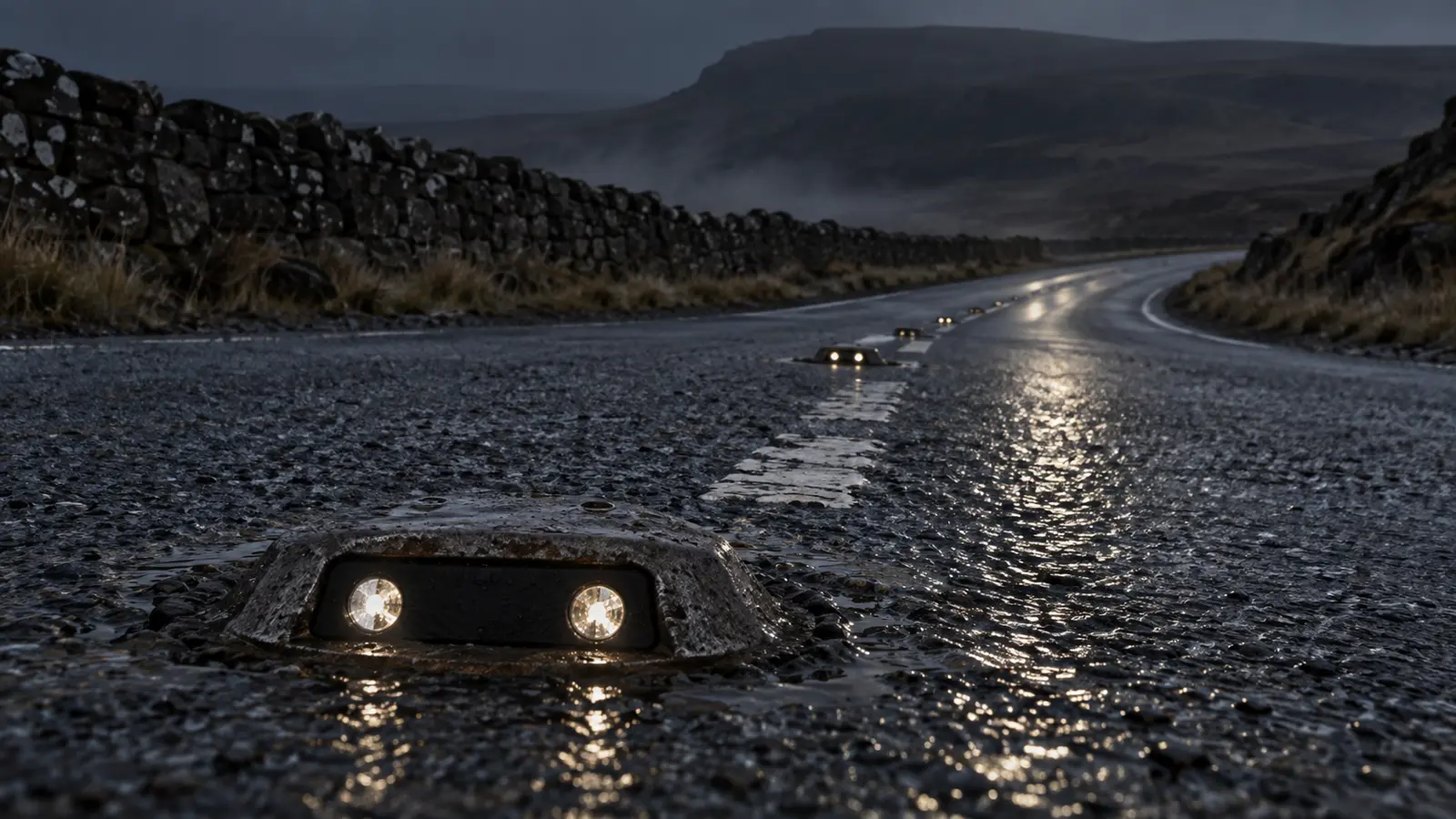
If you have asked why are road studs called cat’s eyes, the name is remarkably literal. The original British design presented a pair of small glass reflectors to approaching headlights, producing two bright points like an animal’s eyes in the dark. Inventor Percy Shaw packaged those reflectors in a tough road-mounted housing, creating a simple guide that drivers could see when paint, darkness, fog or wartime blackouts made the route difficult to follow.
Percy Shaw Wanted the Road to Shine Back
Shaw was a Yorkshire road mender and inventor familiar with hazardous night driving around Halifax. The most famous origin story says that, on a foggy journey in 1933, his headlights caught a cat’s eyes beside the road after reflective tram tracks he normally used as a guide had been removed.
The Design Museum tells that story in connection with a Catseye in its collection. Like many perfect invention anecdotes, it may have become polished through repetition, but the resulting name accurately describes the finished object. Shaw formed Reflecting Roadstuds Ltd in the 1930s, and reflecting studs entered British road use from 1934.
The Trick Is Retroreflection
An ordinary mirror sends light away at an angle determined by how it arrives. A useful road marker needs to do something different: send a concentrated portion of a car’s headlight beam back towards the same vehicle. That behaviour is called retroreflection.
The glass elements in the original stud use curved surfaces and internal reflection to return light towards its source across a useful range of angles. Because the driver’s eyes sit close to the headlights compared with the distance to the stud, the returned light appears conspicuously bright. No electrical power is required; the approaching vehicle supplies the illumination.
Why the Original Had Two “Eyes”
Two reflectors created the recognisable paired glint and allowed a unit to be visible from a chosen direction. Road studs can carry reflectors on more than one face so traffic approaching from either side sees the appropriate signal. Their colour and placement communicate different parts of the road layout.
The pair also helped the popular name stick. “Reflecting road stud” describes the engineering, but “cat’s eye” instantly gives a driver the right mental image: two small points waiting in the road and flashing alive in headlights.
The Rubber Housing Worked Like an Eyelid
Shaw’s design did more than hold glass in the tarmac. The reflectors sat in a flexible rubber insert inside a cast-iron base. When a tyre pressed the rubber down, the glass elements could move into the housing and wipe against a fixed rubber surface.
Rainwater collected in the recess assisted the cleaning action. This led to another feline comparison: the road stud appeared to close and clean its “eyes” under a passing wheel, rather as an eyelid protects an animal’s eye. The protected, self-wiping arrangement improved survival on dirty, wet roads.
Why Cat’s Eyes Mattered in Wartime
Britain’s blackout restrictions during the Second World War reduced street lighting and required buildings and vehicles to limit visible light. Roads became more difficult to read at night. Reflective studs used the carefully controlled light already coming from vehicle lamps, making them valuable without creating a line of powered lights visible from above.
Their usefulness helped turn a local invention into a standard piece of road infrastructure. The government’s own history of traffic signs notes that reflecting road studs—often called cat’s eyes—first came into use in 1934.
What Do the Different Colours Mean?
Modern British roads use coloured studs to reinforce lane and boundary information. White studs commonly mark lanes or the centre of a road. Red indicates the left edge of the carriageway, amber the central reservation of a dual carriageway or motorway, and green marks certain slip-road or lay-by boundaries. Fluorescent green or yellow studs can draw attention to temporary changes.
Drivers should read studs alongside road markings and signs, not as a standalone code learned from one journey. Layouts and permitted products are governed by current traffic-sign rules, and other countries use different colour conventions.
Are All Road Studs Really Cat’s Eyes?
The name is often used generically in Britain, but not every modern stud follows Shaw’s original depressible glass-and-rubber design. Some reflective markers are bonded to the surface, some use different optical elements and some contain LEDs powered by batteries or solar cells.
“Catseye” has also been used as a brand name, while “road stud” is the broader technical term. A solar-powered marker that emits its own light works differently from a passive retroreflector, even if a driver casually calls both cat’s eyes.
Why Not Rely on Painted Lines?
Road paint reflects light too, especially when glass beads are incorporated, but its visibility can fall in heavy rain, darkness, dirt or wear. Raised or embedded studs create bright, discrete points and provide a tactile or audible warning when tyres cross them.
The two systems complement each other. Painted lines show continuous geometry in daylight; studs strengthen that guidance at night and in poor visibility. Their modest size hides how precisely they exploit the relationship between headlights, road surface and driver.
The Bottom Line
Reflective road studs are called cat’s eyes because the original design’s paired glass reflectors looked like a cat’s eyes shining back in headlights. Percy Shaw’s device used retroreflection to return light towards the driver and a rubber mounting that protected and helped clean the reflectors. The feline nickname was memorable because it described both the appearance and the clever mechanical behaviour.
FAQ
Did Percy Shaw really get the idea from a cat?
Short answer: That is the famous account repeated by museums and local histories. Whatever the exact spark, his paired reflectors genuinely resembled illuminated feline eyes.
Do cat’s eyes contain lights?
Short answer: Traditional versions do not. They return a vehicle’s own headlight beam; some modern road studs use powered LEDs instead.
Why do cat’s eyes sink when driven over?
Short answer: In the classic depressible design, the flexible insert protects the reflectors and moves them against a wiping surface that helps remove dirt.
Further Reading
- Why Are British Post Boxes Red? They Used to Be Green
- Why Are London Buses Red? The Colour Became Part of the City
- Why Do LED Lights Flicker on Camera? Your Eyes Usually Miss It
Sources
Into the Catseye :: https://designmuseum.org/discover-your-membership/into-the-collection
Introduction: Know Your Traffic Signs :: https://www.gov.uk/government/publications/know-your-traffic-signs/introduction
Collection of Glass Reflectors Used in Reflecting Road Studs :: https://collection.sciencemuseumgroup.org.uk/objects/co18725/collection-of-glass-reflectors-used-in-reflecting-road-studs-etc