
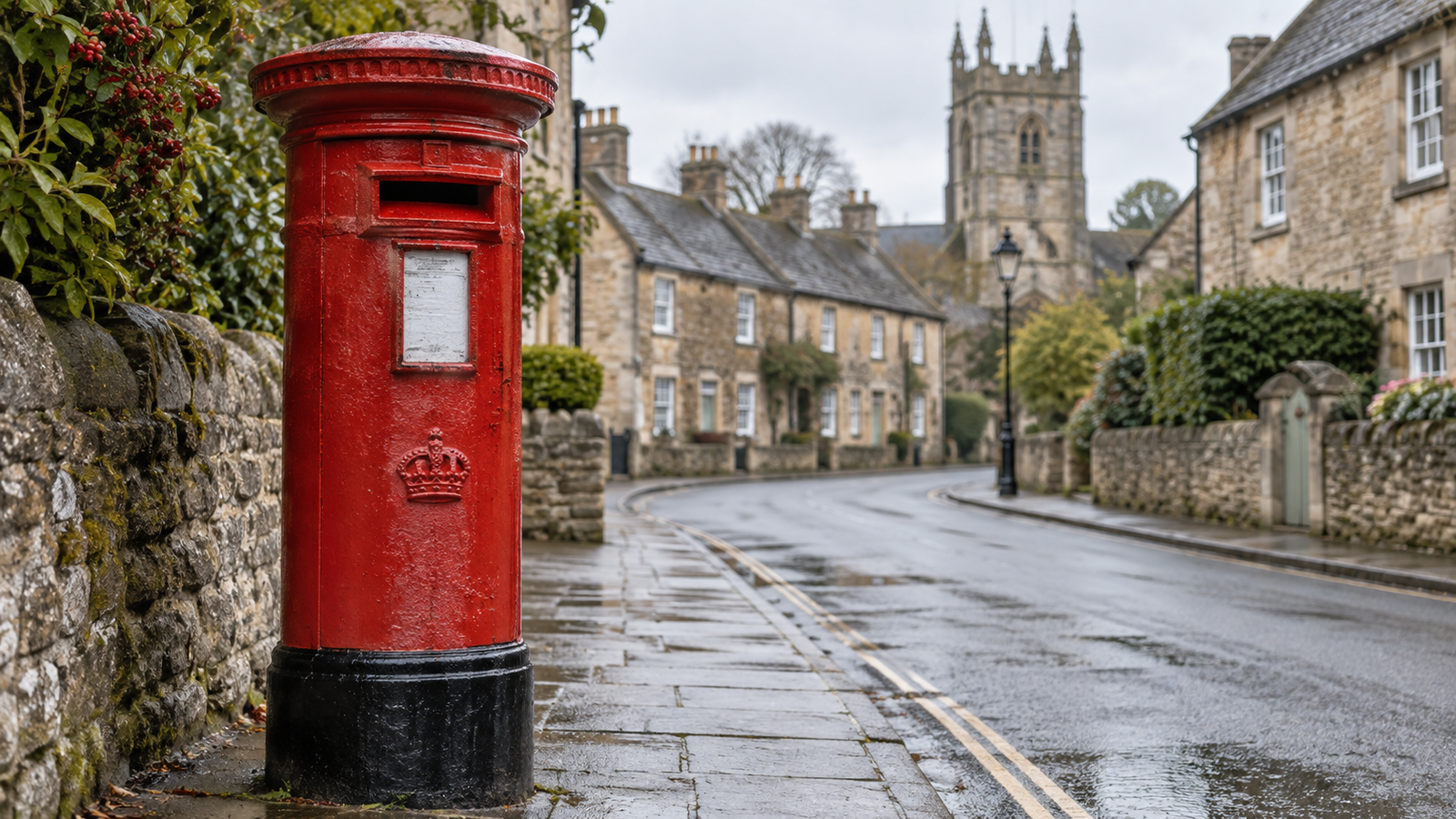
Few objects announce BRITAIN quite as aggressively as a red post box.
Red buses.
Red telephone boxes.
Red pillar boxes.
Apparently at some point the country decided that public infrastructure should be visible from low Earth orbit.
The colour feels inevitable now.
Yet Britain’s post boxes were not originally standardised in red.
For years, many of them were green.
There was just one slight problem.
People kept struggling to find them.
Britain Did Not Always Have Street Post Boxes
For much of postal history, sending a letter involved taking it to a Post Office or handing it into the postal system through other arrangements.
The idea of dropping a letter into a secure public box whenever convenient was not yet part of everyday British life.
One of the people associated with changing that was Anthony Trollope.
Today, Trollope is remembered mainly as a Victorian novelist.
At the time, he also worked for the General Post Office.
While working in the Channel Islands, he recommended adopting roadside letter boxes similar to systems already used elsewhere.
The first British roadside post boxes appeared in Jersey in 1852.
The experiment worked.
Boxes then began spreading across the country.
Early Post Boxes Were Not Standardised
If somebody installed a new post box today shaped like a giant hexagonal vase, questions would probably be asked.
Victorian postal authorities were much more adventurous.
Early boxes appeared in numerous shapes, styles, sizes, and colours.
Some were freestanding pillars.
Some were built into walls.
Some were tall.
Some were squat.
Different districts experimented with their own designs.
This produced a collection of boxes that were individually interesting but hardly represented a single recognisable national system.
Eventually, the Post Office decided some standardisation might be useful.
And in 1859, Britain got its first national standard pillar box.
It was green.
Green Seemed Like a Perfectly Sensible Colour
Victorian Britain did not choose green because officials secretly hated people posting letters.
The colour was respectable and relatively unobtrusive.
That was part of the problem.
A street post box is only particularly useful when people can actually locate it.
Green boxes had an unfortunate tendency to blend into their surroundings.
Against trees, hedges, railings, dark streets, and other urban scenery, they could be surprisingly difficult to spot.
The public complained.
Which means one of the most iconic examples of British street design ultimately owes its existence to nineteenth-century user-experience feedback.
The Post Office Switched to Red
In 1874, the Post Office began moving away from green and painting most boxes a bright red.
The reason was straightforward:
visibility.
Red was dramatically easier to spot.
The change was not instantaneous.
Britain already had large numbers of boxes installed across the country.
Repainting them took years.
Green post boxes therefore continued to exist alongside red ones for some time.
By the end of the nineteenth century, however, red had become firmly established as the familiar Post Office colour.
The bright pillar box had arrived.
Why Red Specifically?
Visibility was the immediate practical reason.
Red stands out strongly against many common natural and urban backgrounds.
But it also fitted an existing postal identity.
Red had already appeared in Post Office and Royal Mail branding, uniforms, and equipment.
Mail coach guards wore scarlet coats from the eighteenth century, and red remained strongly associated with the postal service.
So the switch gave Britain boxes that were both much easier to locate and increasingly recognisable as part of a national postal system.
A practical colour choice gradually became a brand.
Not Every British Post Box Is Red
This is where people who collect postal trivia become dangerous at parties.
Britain contains surviving boxes in other colours.
Historic examples may preserve or recreate older schemes.
Special post boxes have been repainted temporarily for commemorative purposes.
A famous example came after the 2012 London Olympics and Paralympics, when Royal Mail painted selected boxes gold in the home locations of British gold-medal winners.
There are also blue post boxes associated with particular historical uses.
And green historic boxes survive in some locations.
So “British post boxes are red” is overwhelmingly true.
“Every British post box is red” is not.
The Shape Changed Too
Colour was only one part of the evolution.
The now-familiar cylindrical pillar box with a rounded top took time to emerge.
One nineteenth-century design was the Penfold box, introduced in the 1860s.
These were hexagonal and highly decorative.
They looked excellent.
They were also relatively expensive.
Later designs moved towards the simpler cylindrical form that became familiar across Britain.
By 1879, red-and-black cylindrical boxes with convex circular tops had appeared that look much more recognisable to modern eyes.
The Victorians had gradually iterated their way towards the classic post box.
You Can Tell How Old Many Post Boxes Are
Look at the front of an old British post box and you will usually find a royal cypher.
That identifies the monarch reigning when the box was manufactured.
VR indicates Queen Victoria.
ER VII belongs to Edward VII.
GR refers to George V.
GR VI marks George VI.
Boxes carrying the EIIR cypher were produced during the long reign of Elizabeth II.
New boxes produced for the reign of Charles III carry his cypher.
The country therefore contains an accidental outdoor museum of British monarchy.
A box can continue collecting ordinary post for generations after the monarch whose initials appear on it has died.
Why Aren’t All Old Boxes Replaced?
Because cast-iron post boxes are robust.
If a box remains secure, usable, and sensibly located, there may be little reason to replace it simply because the royal cypher is old.
That is why Victorian and Edwardian boxes still survive in active service.
Britain has effectively spent more than a century layering new postal equipment on top of the old rather than replacing everything at each reign.
It is remarkably sustainable for a system nobody designed with that buzzword in mind.
The Red Became More Famous Than the Original Problem
Nobody standing beside a modern British post box thinks:
Ah yes, excellent solution to poor visual contrast against nineteenth-century shrubbery.
The practical problem disappeared into the design.
Red boxes became tourist imagery.
Miniature versions became souvenirs.
They appeared on Christmas cards, postcards, posters, toys, and television.
A colour chosen largely because people could not find the green version became one of the most recognisable pieces of British visual culture.
Which is a pretty decent return on a paint job.
The Bottom Line
British post boxes are red because their green predecessors were too difficult to spot.
Roadside post boxes arrived in Britain in the 1850s, and the first national standard design introduced in 1859 was green.
The colour blended into the environment rather too successfully.
After public complaints, the Post Office began repainting most boxes bright red from 1874.
The colour was highly visible and already fitted wider postal branding.
Over time, it became iconic.
So one of Britain’s most recognisable national symbols exists partly because Victorian customers essentially complained:
Your post box needs better contrast.
FAQ
Were British post boxes originally green?
Many early boxes varied in colour, but Britain’s first national standard pillar box introduced in 1859 was green.
When did British post boxes become red?
The move towards bright red began in 1874, although repainting the existing network took time.
Why was red chosen for post boxes?
The key reason was visibility. Green boxes could be difficult to spot against their surroundings.
Who introduced post boxes to Britain?
Anthony Trollope, the novelist and General Post Office employee, played an important role in recommending roadside boxes. The first British examples appeared in the Channel Islands in 1852.
What do the letters on British post boxes mean?
They are royal cyphers indicating the monarch reigning when the box was produced.
Are all British post boxes red?
No. Historic and commemorative examples exist in other colours, although red is overwhelmingly the standard colour.
Sources
Evolution of the Post Box :: The Postal Museum
Pop It in the Post :: The Postal Museum
Royal Cyphers on Letter Boxes :: The Postal Museum