
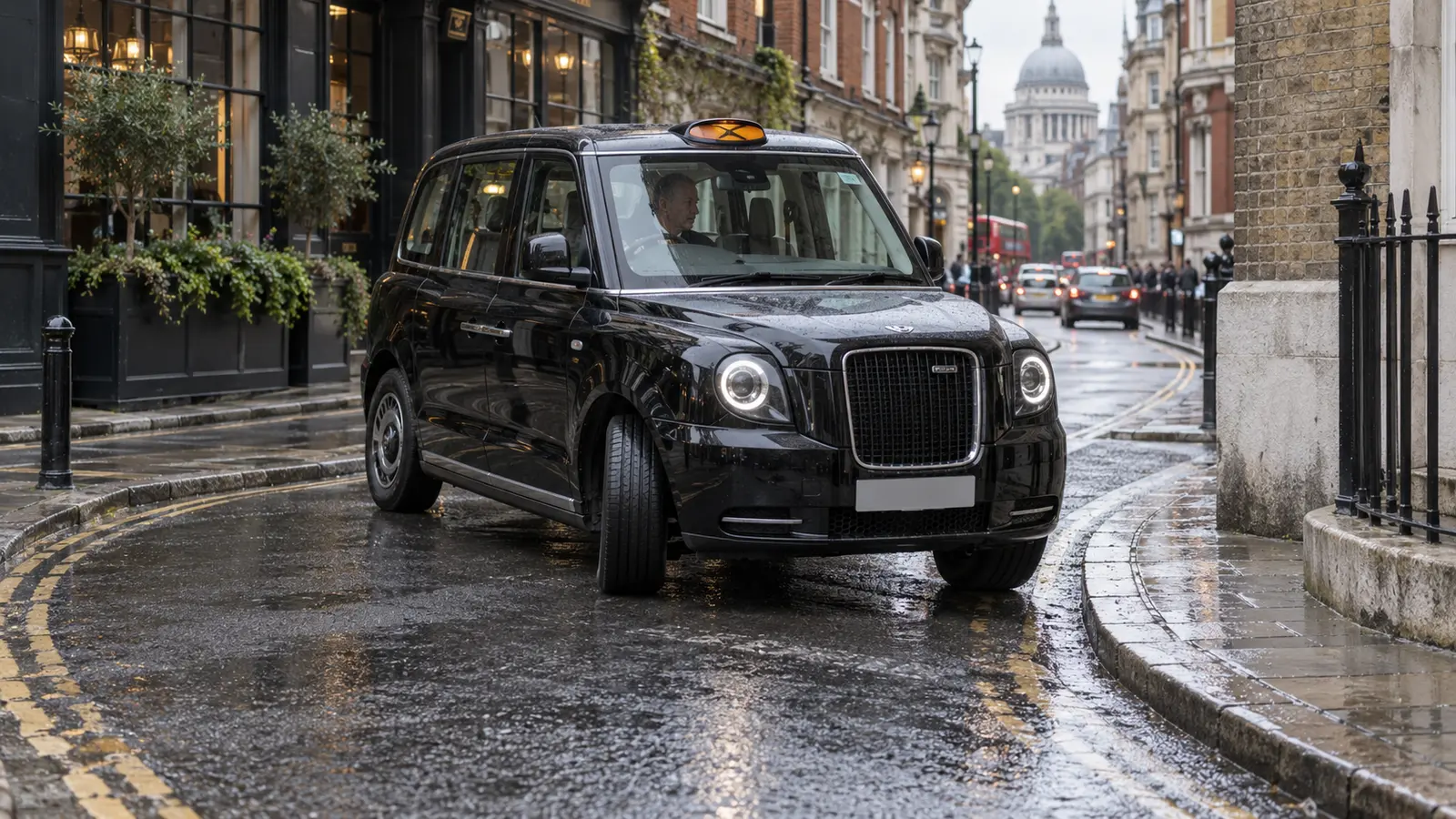
Why can London black cabs turn so tightly when many ordinary cars need a three-point shuffle? It is not merely a happy accident of their shape. A vehicle approved as a London taxi must satisfy Transport for London’s formal manoeuvrability requirements, so manufacturers design the steering and body around a remarkably compact turn.
The rule exists because a working taxi constantly pulls away from kerbs, enters ranks, doubles back for passengers and manoeuvres through cramped streets. A tight turn saves time, reduces reversing and has become one of the defining mechanical features of the London cab.
The Cab Has to Pass a Real Turning Test
TfL’s current Conditions of Fitness say a taxi must be able to turn on either steering lock, face the opposite direction and do it without reversing between two parallel vertical planes no more than 8.535 metres apart. That is a complete vehicle manoeuvre inside an envelope of roughly 28 feet.
The same document includes a 7.62-metre, or 25-foot, kerb-to-kerb wheel-circle measurement. The inspection manual checks both the wheel path and the body sweep. This is why different summaries quote either 25 or 28 feet: they are describing related but not identical parts of the official test.
The wording is technical and the measurement conventions are not wonderfully intuitive, but the result is obvious from the pavement. A compliant taxi must swing around in a space that would leave plenty of normal cars performing an embarrassed correction.
How Is the Tight Turn Engineered?
The front wheels need a large steering angle, often called steering lock. Designers create space inside the wheel arches so the tyres can pivot sharply without rubbing against suspension components or bodywork. The steering linkage must also guide the inside and outside wheels through different arcs, because the inside wheel travels around a smaller circle.
Wheelbase, track width and the amount of bodywork extending beyond the axles all affect the final body sweep. A short wheelbase can help, but a London taxi also needs a large passenger compartment, luggage space, wheelchair access and stable road manners. The engineering challenge is not simply to make the smallest car possible.
Some taxi conversions have used additional rear-wheel steering to satisfy the requirement, while purpose-built cabs traditionally achieve it through their basic chassis and front-steering geometry. Either way, the turning ability has to be demonstrated rather than accepted because the brochure says “urban”.
Why Does London Still Require It?
The Conditions of Fitness began shaping motor taxis in the early twentieth century. London Transport Museum records the 25-foot turning-circle requirement as one of the rules linked to London driving conditions and still in force. Modern TfL documents explicitly connect vehicle dimensions with congested streets, ranks and access.
Taxi work involves more repeated kerbside manoeuvres than ordinary driving. A driver may need to turn around after a hail, change direction near a station or approach a safe dropping point without sending the passenger on an unexpected tour of the borough. Avoiding a multi-stage reverse can also reduce disruption to traffic and people crossing nearby.
The rule has been reviewed rather than preserved completely without question. TfL announced in 2005 that the Conditions of Fitness, including the turning requirement, had undergone review. Arguments against it include the way specialised engineering can limit the pool of suitable vehicles and add cost. The requirement survived because manoeuvrability remained useful to the service.
Is It Really Because of the Savoy Hotel?
A famous story says the 25-foot figure was chosen so taxis could negotiate the small turning area at the Savoy. It is repeated often enough to feel official, but it is safer to treat it as London taxi folklore rather than the sole documented reason for the modern rule.
The current regulatory justification is broader and less glamorous: London has narrow, congested streets, busy ranks and constant pick-ups and drop-offs. The Savoy may provide a neat demonstration, but black cabs do not spend their working lives circling one hotel.
The Rule Shapes More Than the Steering
London taxis must satisfy a long list of other requirements covering accessibility, doors, interior dimensions, visibility, signs, emissions and safety. Current vehicles must accommodate a reference wheelchair, and new models approved since 2018 must meet zero-emission-capable requirements.
That produces an unusual design brief: spacious passenger area, easy access, robust commercial construction and the ability to pirouette through city traffic. The familiar upright body and generous wheel arches are functional consequences as much as visual tradition.
Not every black vehicle with a roof sign is a London taxi, and private-hire cars do not automatically meet the same Conditions of Fitness. “Black cab” refers to a licensed taxi type and service, not merely a paint choice.
The Bottom Line
London black cabs turn tightly because manoeuvrability is built into the licensing standard. The vehicle must reverse its direction without reversing inside a tightly defined space, so manufacturers provide unusually generous steering lock and design the chassis, suspension and body around the test.
The result is useful rather than decorative. In a city full of narrow streets, ranks and awkward kerbs, the cab’s party trick is also a working tool—albeit one that remains extremely satisfying to watch.
FAQ
What Is the Turning Circle of a London Black Cab?
Short answer: The familiar shorthand is 25 feet, while the current TfL test also requires a complete direction change without reversing between planes no more than 8.535 metres, or about 28 feet, apart.
Do All London Taxis Have Special Steering?
Short answer: They must all meet the manoeuvrability standard. Purpose-built cabs usually do it through their steering geometry; some conversions have used rear-wheel steering.
Is the Tight Turn Only for the Savoy?
Short answer: No. The Savoy story is famous, but the practical rule serves manoeuvring throughout London’s narrow and congested streets.
Further Reading
- Why Does Britain Drive on the Left? It Started Long Before Cars
- Why Are London Buses Red? The Colour Became Part of the City
- Why Do Japanese Train Stations Play Melodies? The Tunes Have a Job to Do
Sources
Taxi Conditions of Fitness — Version 11 :: https://content.tfl.gov.uk/taxi-conditions-of-fitness-update-2025.pdf
Taxi and Private Hire Vehicle Licence Inspection Manual :: https://content.tfl.gov.uk/vehicle-licence-inspection-manual.pdf
London Taxis — Conditions of Fitness Review :: https://tfl.gov.uk/info-for/media/press-releases/2005/december/london-taxis–conditions-of-fitness
Collections Close Up: Austin Low Loader Taxi, 1936 :: https://www.ltmuseum.co.uk/collections/stories/transport/collections-close-austin-low-loader-taxi-1936