
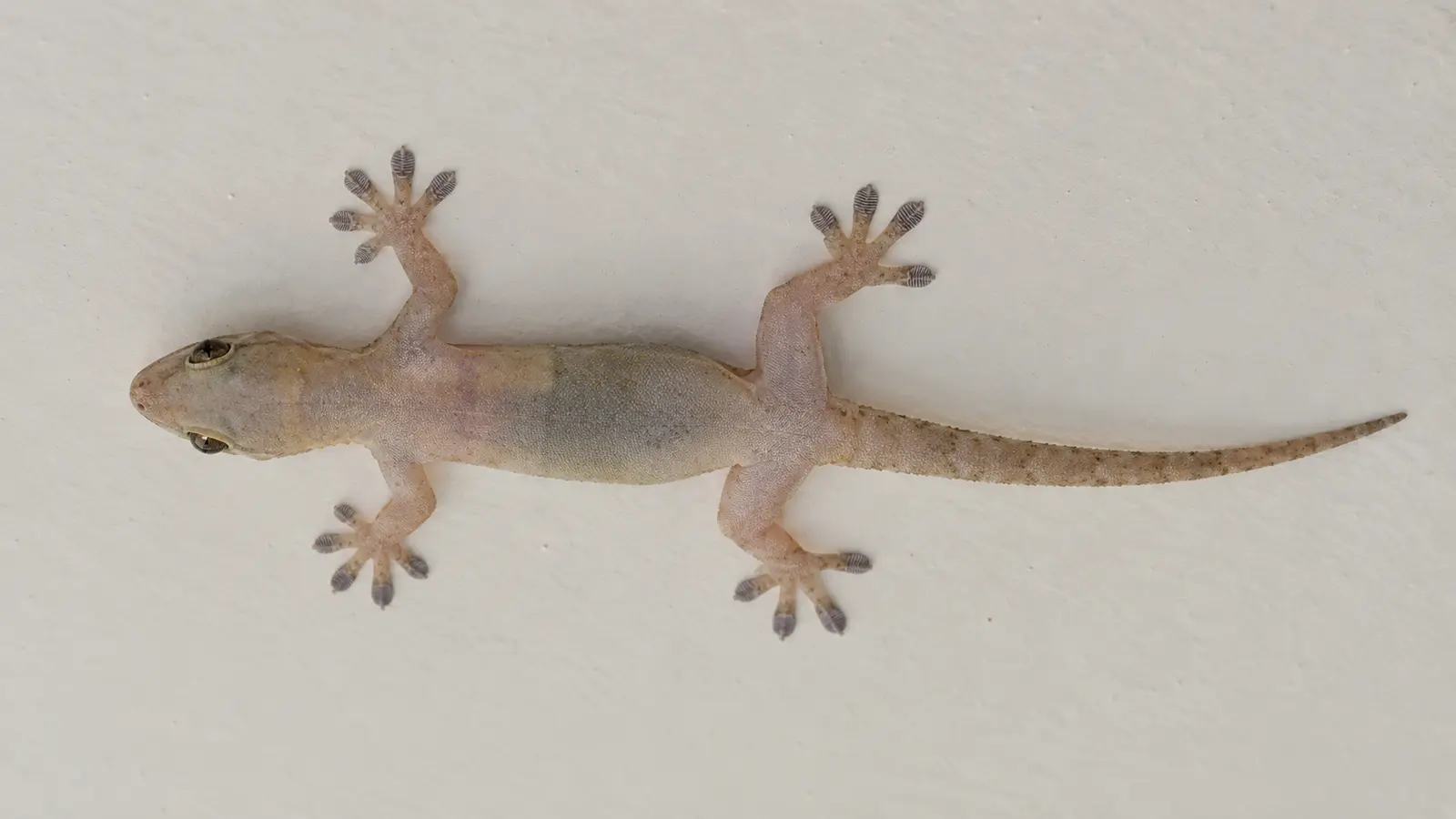
How can geckos walk on ceilings without glue, suction cups or tiny climbing harnesses? The answer is hidden beneath their toes. Adhesive geckos have specialised pads covered by microscopic hairs that branch into even finer tips, creating intimate contact with the surface at an enormous number of points.
Each individual attraction is minuscule, but millions acting together provide enough grip to support the animal. Just as importantly, the system is directional: a gecko can engage the hairs by loading them in one direction, then release them rapidly by changing the angle and peeling its toes away.
The Feet Are Covered in a Hierarchy of Structures
Under an adhesive gecko’s toes are expanded scales often called scansors or lamellae. These carry dense fields of hair-like structures called setae. A seta is far thinner than a human hair and branches at its end into many nanoscale tips known as spatulae.
The branching matters because a flat, rigid toe could only touch the highest points of a surface. Flexible hairs can bend around microscopic bumps, while the tiny spatulae spread across the material. This greatly increases the true contact area even though the wall looks perfectly smooth to us.
Not every gecko species has the same elaborate pads. Adhesive toe structures have evolved, changed and even been lost multiple times within geckos, reflecting different habitats and ways of moving.
Van der Waals Forces Provide the Grip
Atoms and molecules can attract one another through short-range interactions known as van der Waals forces. These forces are normally too weak to notice at human scale. Bring an enormous number of tiny surfaces extremely close together, however, and the combined attraction becomes useful.
Experiments on individual gecko setae provided direct evidence that dry adhesion was consistent with van der Waals forces rather than suction or a liquid glue. The hairs worked on surfaces with very different relationships to water, undermining the idea that a thin moisture film was the main mechanism.
The gecko does not generate a magical new force. Its foot geometry allows an ordinary molecular attraction to be multiplied across millions of contacts. Nature has essentially solved a scale and surface-area problem.
The Toes Switch Adhesion On and Off
A permanent adhesive strong enough to hold a gecko upside down would be useless if every step required a wrestling match. Setae are angled and respond to shear—the force created when the toe is pulled along the surface. The gecko places its foot, uncurls the digits and loads the hairs so their tips make effective contact.
To detach, it changes the direction of force and peels the toes from the tips. Measurements of individual setae found that orientation and a small preload dramatically increased attachment, while raising the hair beyond a critical angle reduced the force needed for release.
The process resembles peeling tape rather than yanking it straight off. A wave of detachment moves across the toe, allowing the gecko to run without surrendering the grip needed to avoid an undignified fall.
Why Do Geckos Sometimes Slip?
The system depends on close contact, so surface condition matters. Very rough materials leave fewer spatulae touching. Loose dust can sit between the hairs and the surface, while water may interfere differently depending on the gecko species, the material and whether the animal’s feet are already wet.
Gecko feet are remarkably self-cleaning, but not because dirt never sticks. During repeated steps, particles can be transferred away from the hairs when their attraction to the walking surface is stronger than their attraction to the setae. Movement gradually restores performance.
Claws can assist on rough bark or stone where microscopic adhesion has less usable area. Geckos therefore combine toe-pad physics, body posture, claws and careful foot placement rather than relying on one flawless superpower.
Could Humans Copy Gecko Feet?
Researchers have developed dry adhesives, climbing robots and gripping devices inspired by the directional structure of gecko toes. The attraction is obvious: a reusable adhesive that works without wet glue, leaves little residue and releases on command could be useful in manufacturing, medicine and robotics.
Copying the animal is difficult. Artificial fibres must be small, flexible, durable and arranged so that millions of contacts engage together. They also need to cope with dust, roughness and repeated use. A gecko grows and maintains its own complex living system; an engineer has to manufacture one consistently.
The Bottom Line
Geckos walk on ceilings because their toe pads divide into microscopic setae and nanoscale spatulae. Those structures conform to the surface and create millions of close contacts, allowing van der Waals attractions to add up into a powerful dry grip.
Directional loading engages the hairs, while peeling the toes changes their angle and releases them. It is less like having glue on each foot and more like operating millions of molecular-scale switches at every step.
FAQ
Do Geckos Use Suction Cups?
Short answer: No. Their toe pads do not require a sealed vacuum; microscopic hairs create close contact and molecular attraction.
Do Gecko Feet Feel Sticky?
Short answer: Not like glue. Their adhesion depends on the direction, angle and loading of the setae against a surface.
Can Every Gecko Walk on Glass?
Short answer: No. Gecko species vary, and not all possess the highly developed adhesive toe pads used by specialist climbers.
Further Reading
- Why Do Cats Knead Blankets? The Surprisingly Sweet Reason Behind It
- Why Do Dogs Tilt Their Heads? Scientists Found a Clue
Sources
Evidence for van der Waals Adhesion in Gecko Setae :: https://polypedal.berkeley.edu/publications/070_Autumn_EvidenceforVanDerWaalsAdhesion_ProcNatAcadSci_2002.pdf
Adhesive Force of a Single Gecko Foot-Hair :: https://polypedal.berkeley.edu/publications/060_Autumn_AdhesiveForceofaSingleGeckoFootHair_Nature_2000.pdf
Rate-Dependent Frictional Adhesion in Natural and Synthetic Gecko Setae :: https://pmc.ncbi.nlm.nih.gov/articles/PMC2842608/