
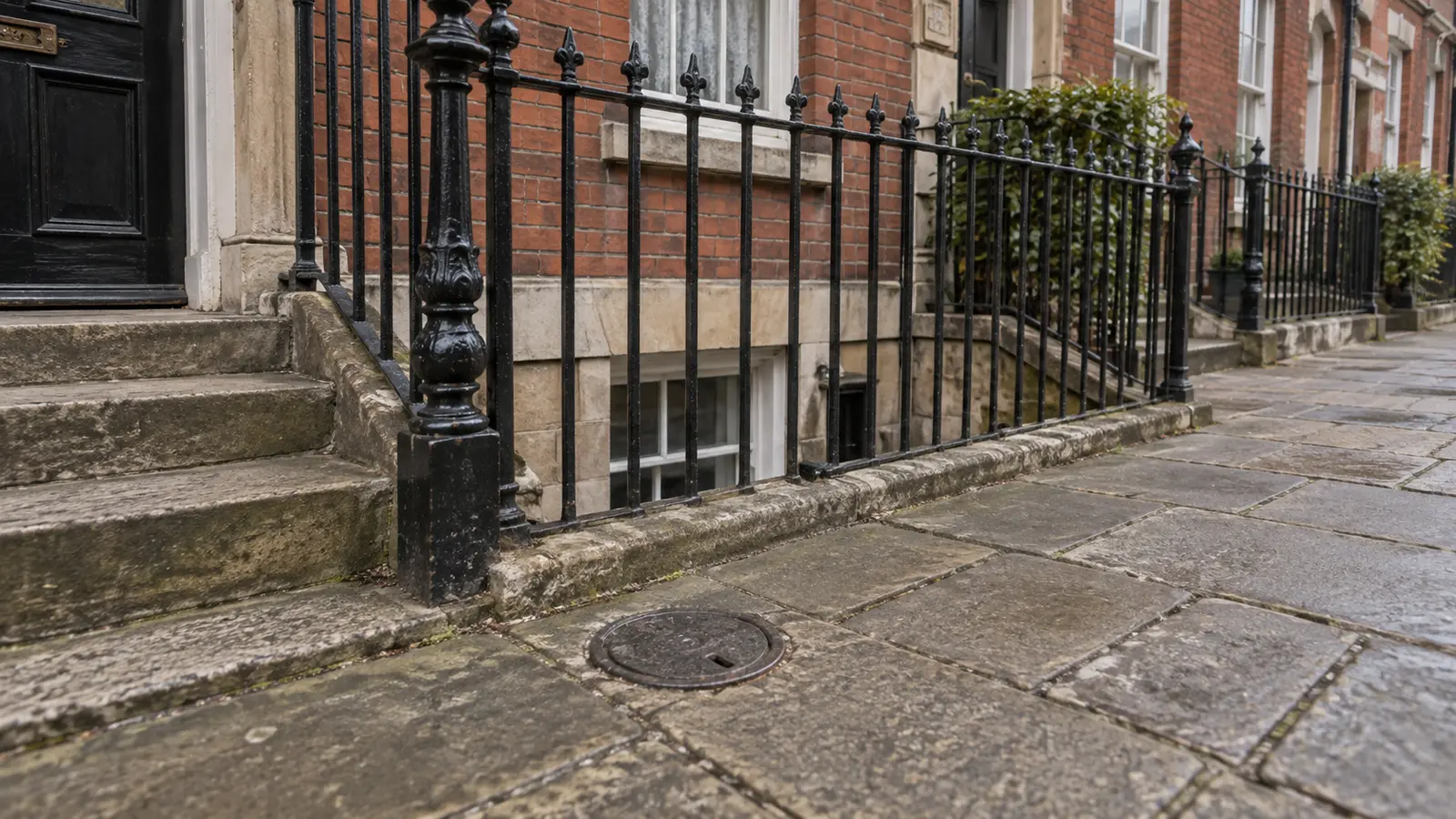
Why Did Old Houses Have Coal Holes? They allowed coal to be delivered directly from the pavement into a cellar or storage space below. A coalman could open the iron cover, tip in a sack, and avoid carrying soot and dust through the house.
Many surviving coal-hole covers look like small manhole covers embedded outside Georgian and Victorian terraces. They are easy to mistake for modern utility access points, but they belonged to an age when a household’s heating and cooking fuel arrived by cart, one dirty sack at a time.
The Cellar Often Extended Beneath the Pavement
In many 18th- and 19th-century terraced houses, vaulted cellars extended beneath the front steps, the basement lightwell, or part of the pavement. That placed the coal store close to the street while keeping it separate from the main living rooms.
A short chute connected the pavement opening to the cellar below. Historic England records surviving buildings with coal drops set directly beneath street-facing windows, and examples also existed in yards or at the end of terraces where one delivery point served several homes.
The arrangement used gravity rather efficiently: lift the cover, empty the sack, and let the coal do the unpleasant travelling.
Coal Was Everyday Household Infrastructure
Before gas boilers and widespread central heating, coal fed domestic fires, kitchen ranges, and boilers. A household needed a practical place to store enough fuel while keeping it dry and reasonably accessible.
That made the coal cellar a working part of the home rather than an eccentric basement feature. Someone inside the household — often a servant in wealthier homes — would carry smaller amounts upstairs from the store to whichever grate or range needed feeding.
The system was labour-intensive, dusty, and ordinary. Heating a room involved repeated handling of solid fuel, clearing ash, and cleaning the soot that escaped despite everyone’s best efforts.
The Hole Kept the Coalman Out of the House
A full coal sack was heavy and coated with dust. Carrying it through a hallway, down stairs, and across domestic floors would spread black grime along the route and turn delivery day into an even larger cleaning job.
The pavement hatch created a direct route to the dirtiest room. Historic England describes coal-hole covers as a way to supply the coal store without traipsing the fuel through the house, while Victorian walking-tour material records coal being dropped from horse-drawn carts straight into cellars.
It also saved effort. The coalman still had to move the sacks from the cart, but gravity handled the final descent.
Why the Covers Were Usually Cast Iron
The cover needed to survive boots, barrows, weather, and the weight of street traffic while remaining removable for deliveries. Cast iron was strong, durable, and easy to manufacture in repeated patterns.
Many covers carry the name of a local ironfounder or supplier. Because companies often sold within a relatively small area, the lettering can reveal where a cover was made and how local building trades operated.
Designs varied. Some were solid, some included ventilation holes, and some incorporated glass to admit light into the basement. An 1868 advertisement for a patented safety plate even promoted a flange intended to stop the lid shifting dangerously when stepped on.
Why Were Coal Holes Often Round?
Circular covers suited both manufacture and use. A round lid has no corners to align when it is replaced, and a properly sized circular disc cannot fall through its own opening. A heavy lid can also be rolled on its edge for a short distance rather than carried flat.
Not every coal opening was circular, and not every old iron disc in a pavement covered coal. Streets also contained water, gas, drainage, and later electrical access points. Pavement lights made with glass blocks can look similar from a distance but were designed to send daylight into rooms below.
Some Coal Holes Served More Than One House
The classic London image is a small hatch outside an individual townhouse, but layouts differed. Historic England’s record of the early-19th-century Hopping Hill terraces in Belper describes a chute running from the road into a shared yard. The road was widened so carts could tip coal directly into it for the surrounding houses.
That larger communal arrangement shows the same basic idea at a different scale: put the delivery opening beside the transport route and let gravity take the fuel closer to where it will be stored.
Why Most Coal Holes Disappeared
As homes moved towards gas, electricity, oil, and central-heating systems, routine sack deliveries of household coal declined. Cellars were converted, chutes were sealed, and many pavement covers were removed, buried, or absorbed into later resurfacing.
Survivors now function as small pieces of street archaeology. Their patterns, maker names, and locations preserve evidence of the infrastructure that once heated the buildings around them.
Some still sit in their original stone surrounds. Others have been reset in concrete or asphalt after the opening beneath was closed, leaving the decorative lid as the last visible clue.
The Bottom Line
Old houses had coal holes so fuel could travel directly from the street into a cellar without a coalman dragging filthy sacks through the home. The iron-covered chute made delivery quicker, cleaner, and better suited to dense rows of urban houses.
What now looks like a mysterious little disc in the pavement was once the household equivalent of a fuel inlet — just with more soot, more servants, and considerably fewer safety labels.
FAQ
Why Did Old Houses Have Coal Holes?
Short answer: Coalmen used them to tip fuel from the pavement directly into a cellar or coal store below the house.
Were Coal Holes Always in the Pavement?
Short answer: No. They could be set into pavements, front steps, yards, or delivery areas shared by several houses.
Why Were Coal-Hole Covers Made From Cast Iron?
Short answer: Cast iron was strong, weather-resistant, and suitable for patterned covers that people could walk over.
Are Old Coal Holes Still Open?
Short answer: Some survive, but many openings have been sealed or filled. The cover may remain even when there is no usable chute underneath.
Further Reading
- Why Did Old Houses Have Boot Scrapers? Streets Used to Be Filthy
- Why Did Victorian Streets Have Horse Troughs? Cities Ran on Animal Power
- Why Were Old Books Chained to Shelves? They Were Worth a Fortune
Sources
78 Dean Street — The Early Georgian Townhouse Walking Tour :: https://historicengland.org.uk/campaigns/visit/walking-tours/spotter-guide-georgian-townhouse/78-dean-street/
Coal Chute, Hopping Hill Terraces, Belper :: https://historicengland.org.uk/education/schools-resources/educational-images/coal-chute-hopping-hill-terraces-shaw-lane-belper-derbyshire-ioe01-10213-11
Coal Holes, Pavement Lights, Kerbs and Utilities :: https://www.designingbuildings.co.uk/Coal_holes,_pavement_lights,_kerbs_and_utilities_and_wood-block_paving