
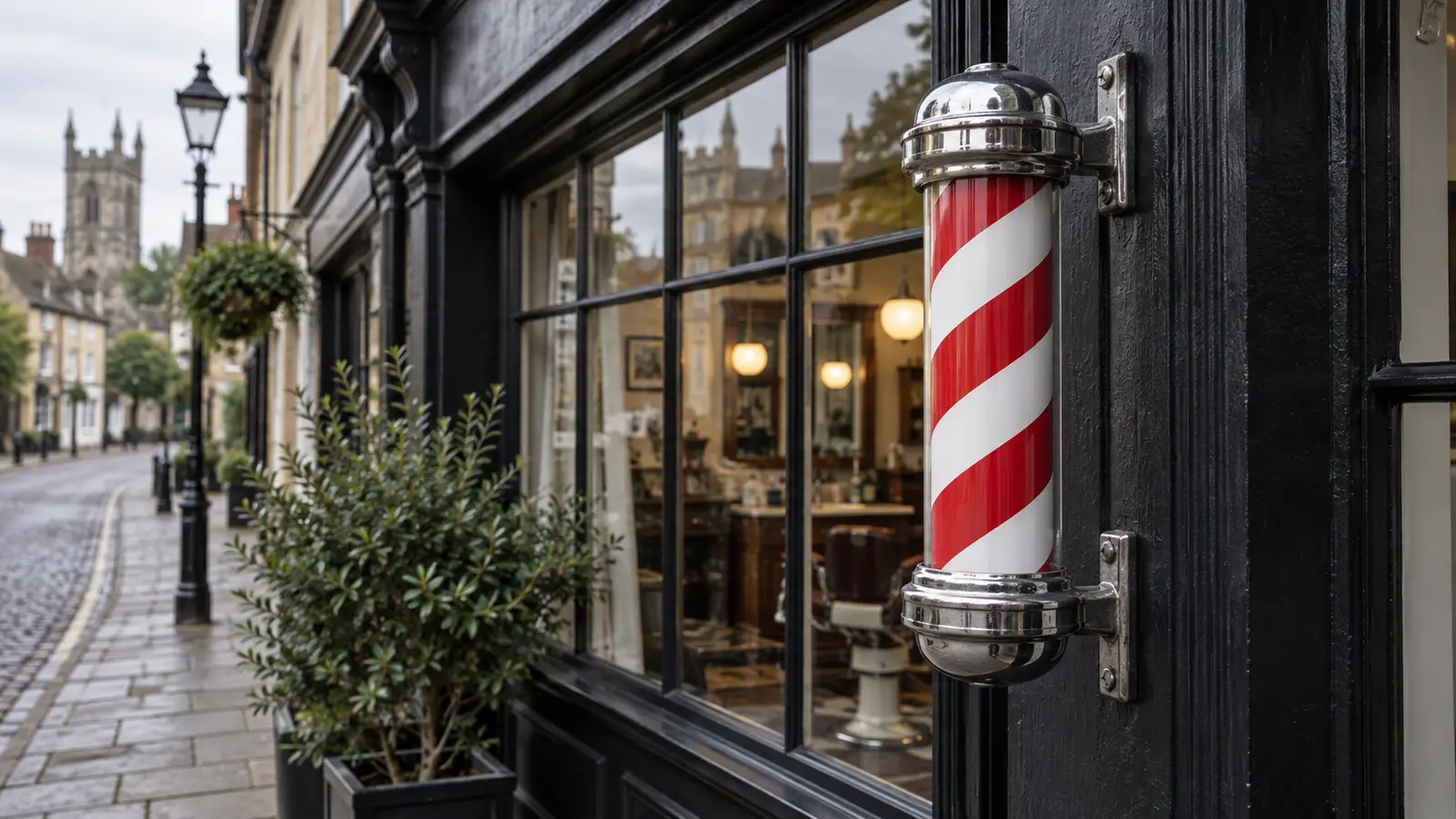
If you have ever wondered why are barber poles red and white, the short answer is that the colours are usually linked to blood and bandages. The longer answer leads back to barber-surgeons: practical tradespeople who once shaved faces, cut hair, pulled teeth, lanced abscesses and performed bloodletting. The modern barber pole is a bright, rotating survivor from an era when grooming and healthcare shared the same doorway.
Barbers Once Did Much More Than Cut Hair
In medieval and early modern Europe, medicine was divided among people with very different kinds of training. University-educated physicians tended to diagnose illness and prescribe treatments, while much hands-on work fell to surgeons and other craftspeople. Barbers already owned sharp blades, had steady hands and worked directly with customers, so some also took on procedures such as tooth extraction, wound care and bloodletting.
That combination produced the barber-surgeon. It sounds odd today, but the overlap made practical sense in a world before modern professional boundaries, anaesthesia and germ theory. A customer might visit the same shop for a shave, a painful tooth or treatment based on the belief that removing blood could restore the body’s internal balance.
What the Red and White Are Said to Represent
The familiar explanation is satisfyingly graphic: red represents blood, while white represents clean bandages or cloth. Some accounts describe bandages being washed and hung outside to dry, where they twisted around a pole in the wind. That image is memorable, but the historical evidence is stronger for the colours as a symbolic reference than for one precise origin story involving laundry.
Museum descriptions of surviving poles connect the red-and-white design with bloodletting and bandages or tourniquets. The safest way to tell the story is therefore not to claim that every stripe has one universally documented meaning, but to say that the design grew from the medical work once performed by barbers. Even historical institutions note that several explanations for the exact colour combination have circulated.
Why a Pole?
The pole itself also fits the bloodletting story. During the procedure, a patient could grip a rod so that the muscles of the forearm tightened and a vein became easier to see. A band or tourniquet might be used above the chosen spot. The trade sign turned that functional rod into an advertisement that could be recognised from the street, including by people who could not read.
Earlier practitioners used other attention-grabbing signs too. Accounts describe bowls of blood being displayed to advertise bloodletting, while extracted teeth could signal dental services. Compared with those options, a painted pole was reusable, visible and considerably less gruesome.
When Barbers and Surgeons Split Apart
Over time, surgery developed into a more formal medical profession and the old combined trade broke apart. The separation did not happen everywhere at once, and rules differed between places. In England, the Barber-Surgeons Company was established in the 16th century, while later reforms drew a firmer line between surgery and ordinary barbering.
Barbers stopped being the neighbourhood option for invasive treatment, but they kept the recognisable pole. That is why a sign born from bloodletting now advertises haircuts, beard trims and hot towels instead of lancets and bleeding bowls. The profession changed dramatically; the branding proved remarkably durable.
Where Does the Blue Stripe Come From?
Many poles, particularly those associated with the United States, add blue to the red and white. A popular modern interpretation treats the colours as arteries, veins and bandages, or simply as a patriotic combination. Historical explanations are less tidy. The Royal College of Physicians of Edinburgh notes that colour rules in 16th-century England distinguished barbers’ blue-and-white poles from surgeons’ red-and-white ones.
That does not provide one universal origin for every blue stripe seen today. Trade symbols evolve as they cross borders, and manufacturers repeat familiar patterns long after the original rules have vanished. What can be said confidently is that red and white have the strongest documented link to the barber-surgeon’s medical past, while blue has acquired additional regional meanings.
Why the Stripes Appear to Move
The spinning illuminated pole is a much later flourish. Its diagonal stripes create the illusion that a continuous band is travelling upwards or downwards as the cylinder rotates. This is the barber-pole illusion, a visual effect in which movement seen through a narrow opening is interpreted mainly from the visible edges. It turned an old trade emblem into an especially noticeable electric sign.
The motion is not part of the original bloodletting symbolism, but it helped the pole survive in crowded modern streets. A static historical badge became a small piece of kinetic advertising that could be recognised at a glance.
The Bottom Line
Barber poles are red and white because barbers once worked as barber-surgeons and carried out bloodletting. The colours came to evoke blood and bandages, while the pole recalled the rod a patient could grip during the procedure. Surgery moved into its own profession, but barbers kept the sign, leaving today’s salons with one of the strangest pieces of medical history still displayed in public.
FAQ
Did barbers really perform surgery?
Short answer: Yes. Barber-surgeons carried out practical procedures including bloodletting, tooth extraction and treatment of wounds, although their work and legal status varied by place and period.
Does the red stripe definitely mean blood?
Short answer: Blood is the best-known and well-supported interpretation, with white linked to bandages or tourniquets. However, historians record more than one explanation for the precise colour scheme.
Why do some barber poles have blue stripes?
Short answer: Blue has different regional explanations. It has been associated with historical trade distinctions, veins and, in the United States, patriotic colouring.
Further Reading
- Why Do British Pubs Have Such Weird Names? The Signs Were Doing a Job
- Why Are London Buses Red? The Colour Became Part of the City
- Why Did Old Houses Have Boot Scrapers? Streets Used to Be Filthy
Sources
Bloodletting at the barber-surgeon’s :: https://wellcomecollection.org/stories/bloodletting-at-the-barber-surgeon-s
Bloodletting :: https://www.rcpe.ac.uk/heritage/heritage-blog/bloodletting
Barber Pole (one of a pair) :: https://emuseum.colonialwilliamsburg.org/objects/84278/barber-pole-one-of-a-pair-see-20067061