
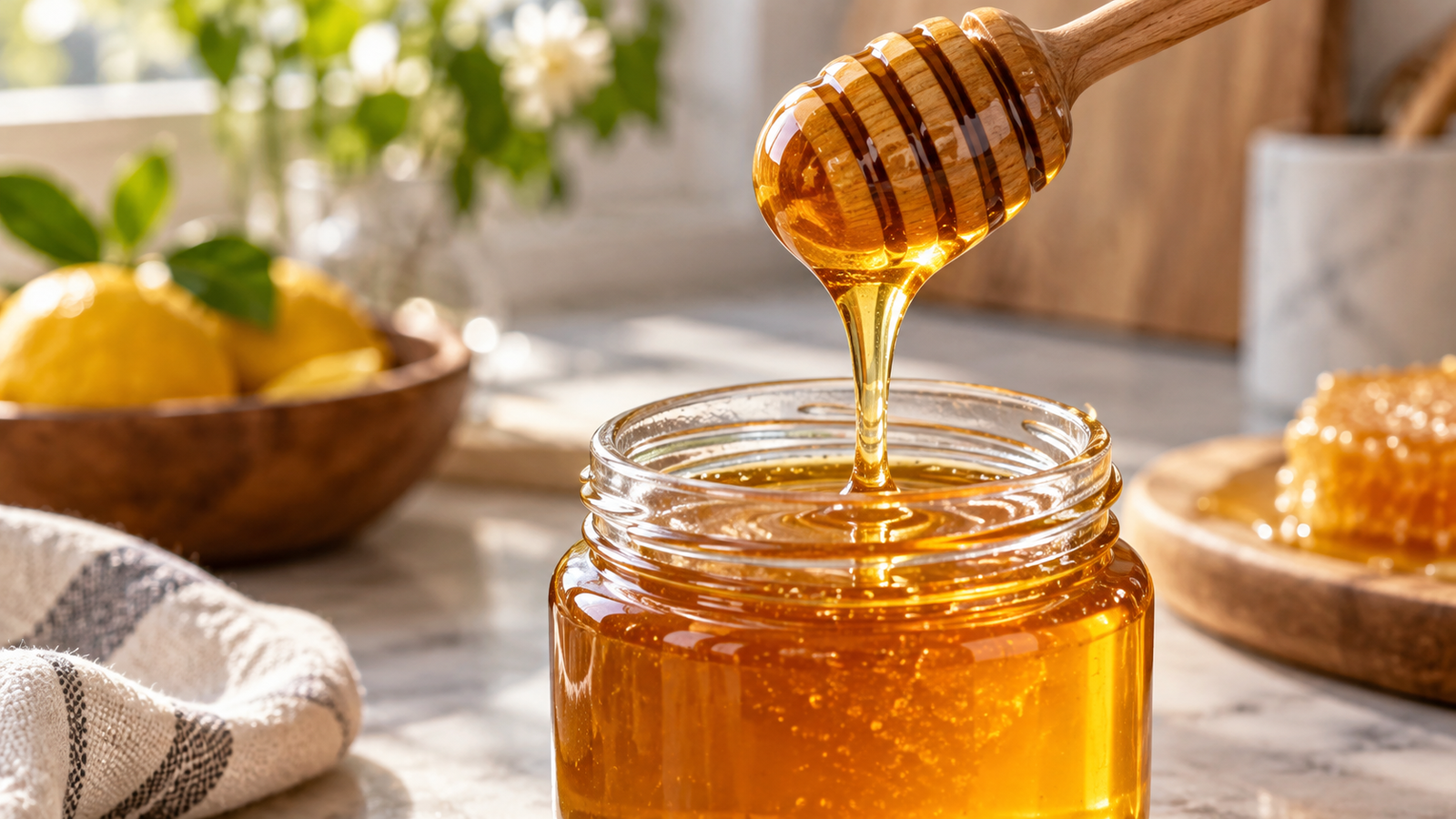
Most food left in a cupboard long enough eventually develops ambitions.
Bread grows mould.
Fruit collapses into something biological.
Milk becomes a science experiment.
Honey, meanwhile, can sit there for years looking broadly unbothered.
It may crystallise.
It may become darker.
It might eventually require some persuasion to get out of the jar.
But properly stored honey is astonishingly resistant to ordinary microbial spoilage.
That has given it an almost mythical reputation as a food that never goes bad.
The truth is slightly more nuanced.
But the chemistry behind honey’s ridiculous shelf life is genuinely impressive.
There Is Surprisingly Little Usable Water in Honey
Microorganisms need water.
Not merely water that technically exists somewhere in the food, but water that is available for them to use.
Scientists describe this using something called water activity.
Honey contains water, typically somewhere around the high teens as a percentage of its mass.
But the huge concentration of dissolved sugars ties much of that water up.
Honey therefore has very low water activity.
For most bacteria and many other microorganisms, that is a major problem.
They simply cannot access enough water to grow normally.
Honey is therefore less like a pleasant sugary swimming pool for bacteria and more like an extremely hostile chemical desert.
All That Sugar Makes Things Even Worse
Honey is packed with sugars, particularly glucose and fructose.
That enormous sugar concentration creates strong osmotic pressure.
If many microorganisms find themselves in concentrated honey, water is pulled out of their cells.
Their normal biological processes stop working properly.
This is the same broad reason why high concentrations of salt or sugar have been used to preserve foods for centuries.
Jam lasts much longer than mashed fruit.
Salted meat lasts longer than fresh meat.
Honey arrives naturally configured as an intensely sugary preservation system.
It is Acidic Too
If dehydration was not enough, honey is also acidic.
Different honeys vary, but researchers commonly report a pH somewhere roughly between 3.2 and 4.5.
Most disease-causing bacteria prefer conditions closer to neutral.
Honey therefore presents microbes with multiple problems simultaneously.
There is little available water.
There is an enormous concentration of sugar.
And the environment is acidic.
Evolution has effectively given honey several layers of defence rather than relying on one.
Honey Has Additional Antimicrobial Chemistry
The story gets more interesting.
Honey also contains compounds that can inhibit microorganisms directly.
Bees add the enzyme glucose oxidase while processing nectar.
When honey is diluted, that enzyme can help generate small amounts of hydrogen peroxide.
Hydrogen peroxide is antimicrobial.
Different varieties of honey also contain numerous plant-derived compounds, including phenolic substances and other chemicals that can contribute to antimicrobial activity.
Some honeys have additional tricks.
Manuka honey, for example, is particularly associated with methylglyoxal, another compound linked with antimicrobial effects.
There is no single “magic ingredient” responsible for honey’s preservation.
Its power comes from several factors working together.
The Bees Have Already Removed Most of the Water
Nectar does not start out like this.
Fresh floral nectar contains far more water than mature honey.
Bees collect it, add enzymes, repeatedly process it, and store it inside the hive.
They also fan their wings to encourage water to evaporate.
The nectar gradually becomes thicker and more concentrated.
Once the moisture level is sufficiently low, bees seal mature honey into the comb with wax.
Humans then arrive wearing protective clothing and steal some of it.
Nature is beautiful.
Can Honey Really Last for Thousands of Years?
This is where the famous story usually appears.
Articles frequently claim archaeologists have discovered edible honey in ancient Egyptian tombs thousands of years old.
The general idea that sealed honey can remain remarkably stable over immense periods is chemically plausible.
The problem is that specific viral claims about archaeologists opening ancient pots and cheerfully eating perfectly preserved honey are often repeated with considerably more confidence than their documentary evidence deserves.
So there is no need to oversell it.
Honey is already extraordinary without inventing an archaeological taste test.
Does Honey Ever Go Bad?
It can.
Honey’s natural defences depend heavily on its concentration.
If enough water gets into the jar, conditions become friendlier for yeasts and other microorganisms.
Honey with unusually high moisture content can ferment.
Poor storage, contamination, or repeated introduction of wet utensils can therefore shorten its useful life.
That is why storing honey sealed and dry matters.
Its preservation system works beautifully when you do not keep adding the main ingredient microbes are missing.
Water.
Why Does Honey Crystallise?
Crystallisation often gets mistaken for spoilage.
It is not.
Honey is a supersaturated sugar solution.
There is so much dissolved sugar that glucose can eventually begin forming crystals.
The honey becomes cloudy, grainy, or almost solid.
Different types crystallise at different rates depending on their balance of sugars, water content, temperature, and other factors.
Crystallised honey is normally still perfectly usable.
Gentle warming can dissolve the crystals again.
The honey has not died.
It has simply changed texture.
Why Does Some Honey Stay Runny Longer?
The ratio of fructose to glucose matters.
Glucose is less soluble in water and therefore crystallises more readily.
Honey containing proportionally more fructose tends to remain liquid for longer.
Temperature matters too.
Storage conditions can either encourage or slow crystallisation.
That means two jars of genuine honey can behave completely differently without either being fake or spoiled.
Does Honey Need to Be Refrigerated?
Usually not.
Honey keeps extremely well in a sealed container at normal room temperature.
Refrigeration can actually encourage some varieties to crystallise more quickly.
The key factors are keeping the container closed and preventing unnecessary moisture from entering it.
A cool, dry cupboard is generally quite enough.
The Bottom Line
Honey lasts an absurdly long time because it is a terrible environment for most microorganisms.
Its huge sugar concentration leaves very little water available for microbes.
That same sugar creates osmotic pressure that can draw water out of microbial cells.
Honey is acidic.
It also contains additional antimicrobial chemistry, including systems capable of producing hydrogen peroxide.
None of this makes honey literally indestructible.
Add enough moisture and fermentation can happen.
But properly stored mature honey comes with an unusually effective preservation system already built in.
The bees did most of the food preservation before you even bought the jar.
FAQ
Does honey ever expire?
Properly stored honey can remain stable for extremely long periods, although flavour, colour, and texture can change over time.
Why doesn’t bacteria grow easily in honey?
Honey has very low water activity, extremely high sugar concentrations, acidic conditions, and additional antimicrobial compounds.
Is crystallised honey bad?
No. Crystallisation is a normal physical change and does not usually mean the honey has spoiled.
Can honey ferment?
Yes. If its moisture content becomes high enough, certain yeasts can grow and fermentation can occur.
Should honey be kept in the fridge?
It generally does not need refrigeration. A sealed container stored somewhere dry at room temperature is normally suitable.
Sources
Selected Honey as a Multifaceted Antimicrobial Agent: Review of Compounds, Mechanisms, and Research Challenges :: https://pmc.ncbi.nlm.nih.gov/articles/PMC12153394/
The Role of Honey in the Ecology of the Hive: Nutrition, Detoxification, Longevity, and Protection Against Hive Pathogens :: https://pmc.ncbi.nlm.nih.gov/articles/PMC9359632/
Honey Microbiota, Methods for Determining the Microbiological Composition and the Antimicrobial Effect of Honey – A Review :: https://pmc.ncbi.nlm.nih.gov/articles/PMC11214184/