
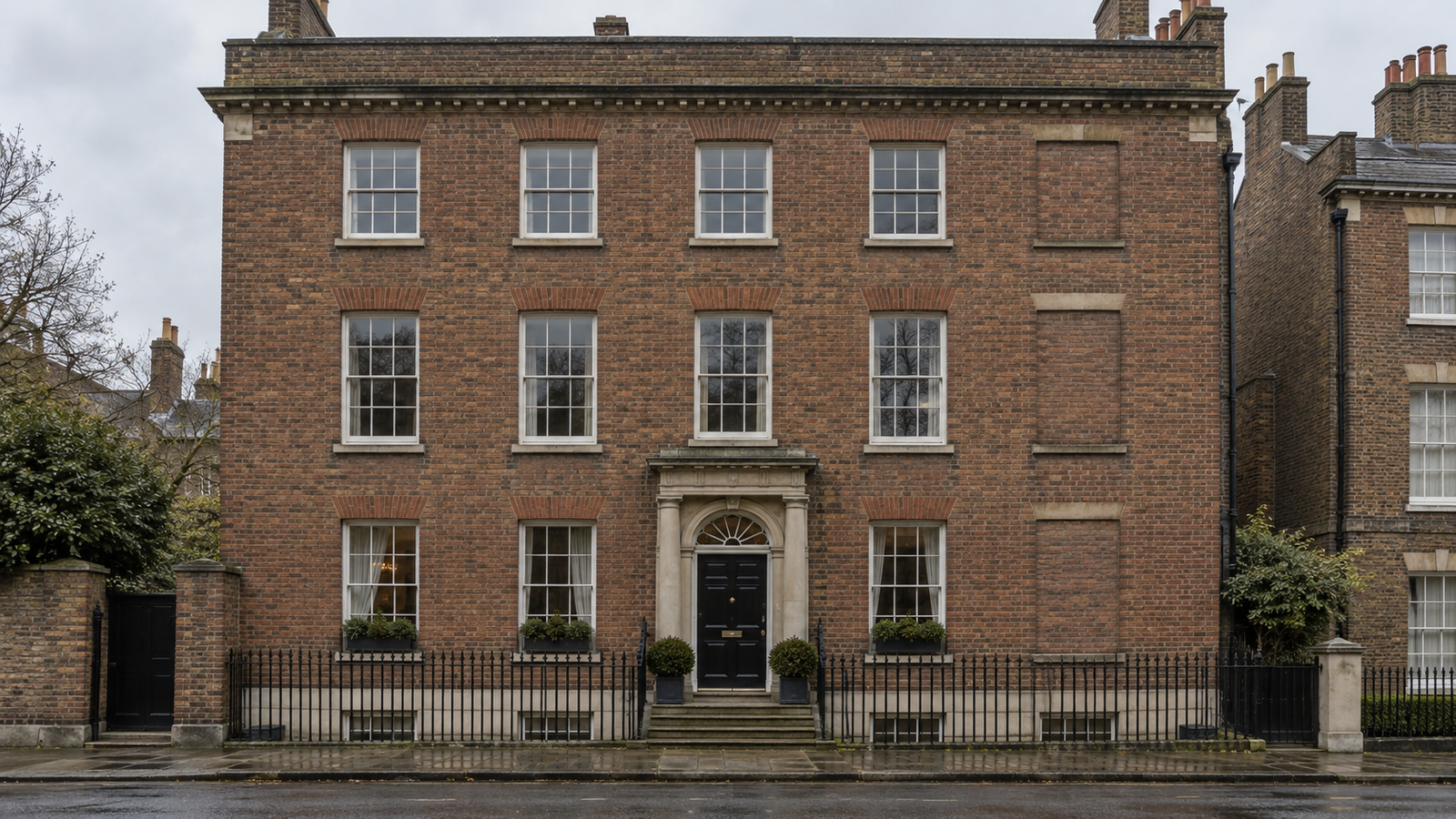
Walk around an old British town and eventually you will spot one.
A handsome Georgian or Victorian-looking building.
Regular rows of windows.
And then, halfway across the wall, an extremely suspicious rectangle of bricks.
It is exactly the size and shape of a window.
It is exactly where a window would make architectural sense.
And yet somebody has apparently decided that daylight was getting a bit excessive.
The explanation you will usually hear is immediate:
Window Tax.
For once, the popular historical story is not complete nonsense.
Britain really did tax houses partly according to how many windows they had.
People really did block windows to reduce their bills.
Parliament complained about them doing it.
But there is an important catch.
Not every bricked-up window you see today was caused by the tax.
The Tax Began in 1696
The Window Tax was introduced in England in 1696 during the reign of William III.
The government needed revenue, including money to support war with France.
Directly assessing somebody’s income or wealth was difficult.
Windows provided a wonderfully crude alternative.
A large house usually had more windows than a small house.
More windows therefore suggested greater wealth.
The tax began as a levy on houses with additional charges related to the number of windows.
Rates and thresholds changed repeatedly over its long life.
But the basic principle remained recognisable.
Own a house with more taxable windows, pay more tax.
It Was Essentially a Wealth Tax You Could Count From Outside
This had one major administrative advantage.
Tax collectors did not necessarily need to know how much money somebody earned.
They could inspect the property.
A grand house with enormous numbers of windows was unlikely to belong to somebody surviving on pocket change.
The system therefore acted as a rough proxy for wealth.
Unfortunately, “rough proxy” and “perfectly fair tax system” are not the same thing.
Two homes could have similar numbers of windows while containing very different numbers of people.
Landlords could pass costs on through rents.
Urban buildings could be heavily affected.
And one very obvious route to reducing the tax bill presented itself.
Remove some windows.
People Really Did Brick Them Up
This part is not folklore.
Contemporary records explicitly describe householders stopping up windows to avoid the tax.
In 1850, during parliamentary debate over the levy, MPs referred back to eighteenth-century reports describing the practice as widespread.
Legislation itself had previously complained about people blocking windows in order to evade payment.
So yes: if you have heard that Britain once taxed windows so people filled them with bricks, that genuinely happened.
Human beings encountered a tax based partly on visible holes in their houses and responded by getting rid of some visible holes.
This outcome should surprise nobody who has ever filled in a tax return.
Did People Literally Brick Every Window Shut?
No.
Different methods could be used to make openings non-taxable depending on the rules operating at the time.
Windows might be filled, boarded, altered, or otherwise closed.
And householders were not continuously rebuilding entire façades every time the tax changed.
The physical evidence we see today is only a small surviving fragment of a much larger historical practice.
Some blocked openings were later restored.
Others remained sealed long after the tax disappeared.
And some were never genuine windows in the first place.
This Is Where the Myth Gets Carried Away
See a blocked rectangle on an eighteenth-century building and Window Tax is certainly a possibility.
It is not proof.
Architects often used blind windows — recesses deliberately designed to look like windows without ever containing glass — to preserve symmetry.
Buildings were extended and altered.
Internal layouts changed.
Fire regulations changed.
Doors became windows.
Windows became doors.
Neighbouring structures disappeared.
Some openings were blocked for privacy, structural reasons, or changes in how rooms were used.
And plenty of supposedly “Window Tax” buildings were constructed after the tax had already been abolished.
So the sensible historical answer is:
Some blocked windows absolutely were caused by Window Tax.
Others simply look like they were.
Why Was the Tax So Unpopular?
Because daylight and ventilation are not frivolous luxuries.
By the nineteenth century, campaigners increasingly attacked the Window Tax on public-health grounds.
Poorer urban residents could live in crowded housing where reducing windows worsened ventilation and natural light.
Critics referred to the levy as a tax on light and air.
That was a politically powerful description because it highlighted the absurd result of the system.
A tax intended as a proxy for property wealth could actively encourage buildings to become darker and less ventilated.
Exactly the opposite of what rapidly growing industrial towns needed.
Did the Tax Create the Phrase “Daylight Robbery”?
Probably not.
This is another wonderfully satisfying story that gets repeated because it feels true.
The claim goes that Window Tax was literally “robbing” people of daylight, creating the phrase “daylight robbery”.
Unfortunately, the documented history of the phrase does not support such a neat origin.
The expression appears to have developed later with a different meaning.
It is a textbook example of folk etymology: a story that sounds so perfect that people keep repeating it even when the linguistic evidence refuses to cooperate.
The Window Tax does not need the embellishment.
It was already sufficiently weird.
When Was Window Tax Abolished?
After more than 150 years, the tax was repealed in 1851.
By then criticism had become difficult to ignore.
Britain was experiencing enormous urban growth.
Public-health reform was becoming increasingly important.
Ideas about ventilation, sanitation, overcrowding, and disease were changing.
Encouraging people to reduce the number of windows in buildings was looking less like clever taxation and more like an actively terrible idea.
The tax was replaced with other forms of property taxation.
The bricked rectangles, however, did not all disappear with it.
Why Didn’t People Just Reopen the Windows Afterwards?
Some did.
But restoring a window costs money.
The room behind it might have been reorganised during the decades it was closed.
Furniture, partitions, pipes, chimneys, or later alterations could make reopening it inconvenient.
Owners also had little reason to restore windows in rooms where the missing light no longer mattered.
And once a building has accumulated a century or two of alterations, determining exactly why one specific opening was blocked can become surprisingly difficult.
Buildings remember history very badly.
They tend to keep the evidence while losing the explanation.
The Bottom Line
Britain’s Window Tax really did encourage people to block windows.
Introduced in 1696, the tax used the number of windows as one indicator of a property’s value.
Householders responded exactly as you would expect: some closed windows to reduce their liability.
The practice became widespread enough to appear in official complaints and parliamentary debate.
But the story comes with an important warning.
A blocked window is not automatically a Window Tax window.
Some were architectural features from the beginning.
Others were altered for completely unrelated reasons.
So the next time somebody points at a bricked-up window and confidently declares, “Window Tax”, the correct response is:
Possibly.
Which is less exciting, but considerably better history.
FAQ
Was Window Tax a real tax?
Yes. It was introduced in 1696 and remained in force, with numerous changes, until 1851.
Did people really brick up windows to avoid tax?
Yes. Historical records explicitly describe people blocking windows to reduce their tax liability.
Was every bricked-up window caused by Window Tax?
No. Blind windows, structural changes, alterations to room layouts, and later building work can all produce similar-looking features.
Why were windows used to calculate tax?
The number of windows provided a visible rough indicator of the size and value of a property at a time when directly assessing wealth was more difficult.
When was Window Tax abolished?
It was repealed in 1851.
Did Window Tax create the phrase “daylight robbery”?
There is no good evidence for the popular claim that the phrase originated with Window Tax.
Sources
Window Tax, House of Commons Debate, 9 April 1850 :: https://api.parliament.uk/historic-hansard/commons/1850/apr/09/window-tax
Repeal of the Window Tax, House of Commons Debate, 17 May 1825 :: https://api.parliament.uk/historic-hansard/commons/1825/may/17/repeal-of-the-window-tax