
C
Image Alt Text
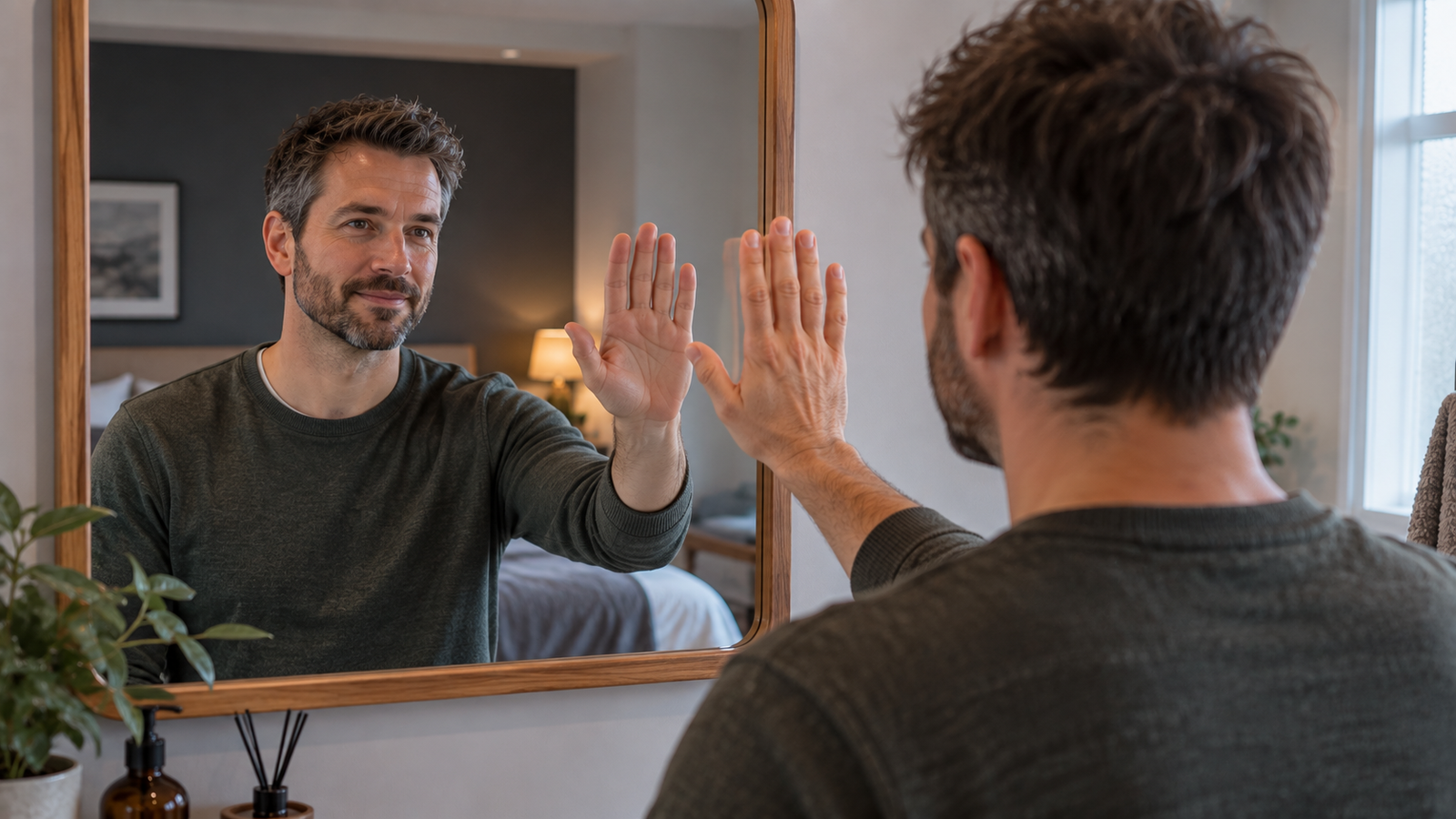
Person raising one hand while looking at their reflection in a mirror
ARTICLE
Stand in front of a mirror and raise your right hand.
The person staring back appears to raise their left hand.
Perfectly normal.
Now consider the obvious problem.
Your head has not moved to the bottom.
Your feet have not appeared on the ceiling.
So how does a sheet of reflective glass apparently understand the concepts of left and right while completely ignoring up and down?
It doesn’t.
The mirror is innocent.
It never flipped your left and right in the first place.
Move Right and Your Reflection Also Moves Right
Try this in front of a mirror.
Move your hand towards the right-hand edge of the mirror.
Your reflection’s hand moves towards exactly the same edge.
Move your hand upwards.
The reflected hand goes upwards.
Move left.
The reflection goes left.
Nothing has been swapped along either of those directions.
Now move your hand directly towards the mirror.
Your reflection moves towards you.
Move backwards away from the mirror and the reflection appears to retreat deeper behind it.
That is the direction that has changed.
The mirror reverses the axis running towards and away from its surface.
Or, in everyday language, front and back.
Why Does It Look Like Left and Right Have Swapped?
Because you instinctively interpret the reflection as another person facing you.
Imagine somebody standing beside you with their right hand raised.
To turn around and face you, they rotate their body.
Once they have turned, their raised right hand appears on your left-hand side.
Your brain is incredibly accustomed to this relationship.
People facing you have opposite left and right orientations from yours.
So when you look at a mirror image, your brain interprets it as though the person in the mirror has somehow turned around to face you.
But the reflection has not rotated.
It has been reflected.
That subtle difference creates the illusion.
Your Reflection’s Right Hand Is Still on the Same Side
This sounds wrong until you look carefully.
Raise your right hand.
It appears on the right-hand side of the mirror from your own viewpoint.
A watch on your left wrist still appears on the left side of the image.
A spot on the right side of your face remains on that same side of the reflected picture.
The geometry has not secretly exchanged everything horizontally.
What changes is the apparent front-to-back orientation.
We then label the reflected figure as if it were an ordinary person standing opposite us, and that is where the apparent left-right swap enters the story.
Writing Makes the Effect Look More Convincing
Mirror writing seems like slam-dunk proof that mirrors reverse left and right.
Write HELLO on a piece of paper and hold it towards a mirror.
The text appears backwards.
Case closed.
Except think about what you did to show the writing to the mirror.
You turned the paper around.
If the writing begins facing you, you must rotate the sheet so that its front faces the mirror.
The mirror then accurately reflects the orientation presented to it.
A transparent sheet makes this much easier to see.
Write a word on transparent plastic, hold it towards the mirror without turning it around, and compare what you can see directly through the material with the reflected version.
The supposed magical left-right switch becomes considerably less magical.
Why Doesn’t the Mirror Turn You Upside Down?
For exactly the same reason it does not really reverse left and right.
Directions running parallel to the mirror stay parallel.
Up stays up.
Down stays down.
Left stays left.
Right stays right.
The direction perpendicular to the mirror is the one that reverses.
A point ten centimetres in front of the mirror appears ten centimetres behind it.
That is what plane-mirror geometry does.
Gravity has absolutely nothing to do with the reflection.
The mirror does not know which way the floor is.
Would a Mirror Behave Differently if You Lay Down?
No.
Turn your body sideways or lie down and the underlying reflection rule remains exactly the same.
What changes is your interpretation of the image.
Our everyday language of left, right, above, below, front, and back is attached to bodies and viewpoints.
The physics itself is much simpler.
A flat mirror reflects light so that the angle at which the light arrives equals the angle at which it leaves.
Our brains then reconstruct those reflected rays as though they travelled in straight lines from behind the mirror.
That creates the virtual image we see.
What About Two Mirrors?
Two reflections can undo the familiar handedness effect.
Place two mirrors at an appropriate angle and the second reflection reflects the first.
This is why multiple-mirror systems can create images that look different from the ordinary bathroom-mirror version of your face.
Each reflection changes the orientation perpendicular to its own mirror surface.
Stacking reflections changes the geometry again.
Apparently even mirrors can solve a problem by delegating it to another mirror.
Why Does Your Face Look Strange When a Photo Is Flipped?
There is an extra psychological wrinkle.
You see your face in mirrors constantly.
That reflected version becomes extremely familiar.
A normal photograph shows the orientation other people usually see instead.
Because human faces are not perfectly symmetrical, small differences suddenly appear on unfamiliar sides.
That can make a photograph feel strangely “wrong” even though everybody else thinks it looks perfectly normal.
The mirror has spent years quietly training you to prefer the reversed version.
The Bottom Line
Mirrors do not actually flip left and right.
They do not flip up and down either.
A flat mirror reverses the direction perpendicular to its surface — what we usually describe as front and back.
The apparent left-right reversal happens because we mentally compare the reflection with another person who has turned around to face us.
The mirror never performed that rotation.
Your brain did.
Which means one of the most familiar things you see every day has probably been getting blamed for something it never actually did.
FAQ
Do mirrors really reverse left and right?
No. A flat mirror reverses the direction perpendicular to its surface rather than specifically swapping left and right.
Why does mirror writing look backwards?
We normally rotate writing around to present it to a mirror, and the reflection preserves the geometry created by that rotation.
Why doesn’t a mirror flip things upside down?
Up and down run parallel to an upright mirror, so their positions are preserved just like left and right.
What direction does a mirror actually reverse?
It reverses depth — the direction towards and away from the mirror.
Why do photographs sometimes look stranger than mirror images?
You are extremely familiar with your reflected face, while photographs often show the opposite orientation. Small facial asymmetries can therefore seem unusually noticeable.
Sources
Left-to-Right Reversal – Purdue University Department of Physics and Astronomy :: https://www.physics.purdue.edu/demos/display_page.php?item=7A-03
Images Formed by Plane Mirrors – OpenStax University Physics :: https://openstax.org/books/university-physics-volume-3/pages/2-1-images-formed-by-plane-mirrors
Why Do Mirrors Flip Left to Right and Not Up to Down? – West Texas A&M University :: https://www.wtamu.edu/~cbaird/sq/2013/01/05/why-do-mirrors-flip-left-to-right-and-not-up-to-down/