
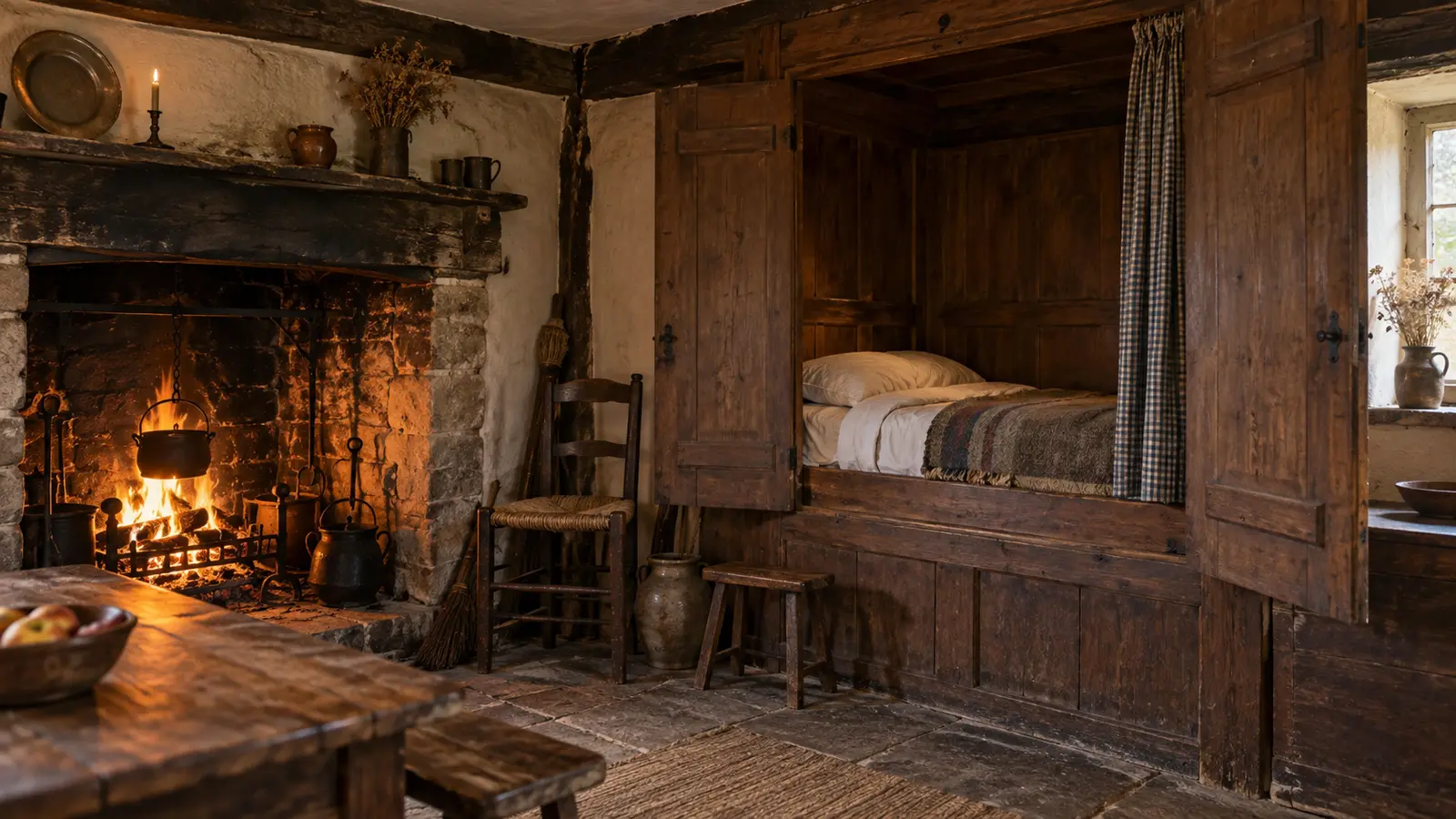
Why did people sleep in box beds that looked as if somebody had put a mattress inside a wardrobe? In homes where one room might serve as kitchen, workplace, sitting room and bedroom, enclosing the bed created a warmer and more private sleeping space without requiring another room.
Box beds were not one universal medieval design. Regional versions appeared in Scotland, Wales, northern England, Brittany, the Netherlands and elsewhere, using wooden doors, sliding panels or curtains. Some were built into the room; others were substantial pieces of furniture. The shared idea was simple: make a small room around the bed.
What Was a Box Bed?
A box bed, cupboard bed or closed bed surrounded the mattress with timber on several sides. The front might remain partly open, close with fabric or have proper wooden doors. Shelves, benches and storage were sometimes incorporated around it, making the whole structure work as more than a bed.
Surviving examples show how varied they were. Museum Wales records a pine cupboard bed from Nantcwnlle and describes a box bed beside the fire as a particular feature of Gower homes. The National Trust for Scotland preserves a pine example fitted into the main room of Robert Burns’s childhood cottage.
That evidence matters because internet retellings often turn “the box bed” into a single European craze lasting unchanged for centuries. In reality, people adapted enclosed sleeping spaces to local homes, materials and customs.
A Small Enclosure Held On to Warmth
Historic homes could be cold, draughty and unevenly heated. A fire warmed the main room, but heat escaped through chimneys, doors, roofs and uninsulated walls. The air inside a partly enclosed bed was easier for sleeping bodies, blankets and perhaps a warming pan to heat than the entire room.
Wooden sides and curtains reduced moving air around the sleeper. Positioning the bed near the hearth could also take advantage of the warmest part of the house. At Kennixton farmhouse, now at St Fagans, the box bed stood by the fire in the living area.
The enclosure did not create modern central heating, and shutting it too tightly would have made the space stuffy. It simply improved the immediate microclimate around the mattress. A few degrees and less draught can make a heroic difference when the alternative is a cold open room.
Privacy Mattered in Shared Rooms
Separate bedrooms were not available to everyone. Families, servants, lodgers and workers could sleep in rooms used by other people before and after bedtime. Closing a curtain or door provided a visual boundary and softened some noise and light.
That private pocket was useful for dressing as well as sleeping. It could separate generations or give a married couple a degree of seclusion in a household where domestic life happened within earshot. The box bed was architecture on a furniture budget.
Some examples were stacked or arranged alongside other built-in storage. In small dwellings, using the wall efficiently left more floor space free during the day. A freestanding bed permanently occupying the centre of the room was a luxury of space many households did not possess.
They Were Not Just for One Social Class
Box beds are strongly associated with rural cottages and working households because many surviving examples come from those settings. That does not mean every user was destitute, or that enclosed beds were identical markers of poverty.
Materials and decoration ranged from plain pine to heavily carved fronts. In Brittany, the lit-clos became a distinctive piece of regional furniture. In Dutch homes, related sleeping recesses known as bedsteden were often built into walls. The practical advantages could appeal at different income levels even when the finish and scale differed.
Nor is the common claim that all old box beds were short because people routinely slept sitting upright particularly convincing. Mattress sizes reflected room dimensions, local furniture and the stature of users. Propped pillows existed, but people in the past still understood lying down.
Why Did Box Beds Disappear?
Housing gradually changed. More homes gained dedicated bedrooms, improved chimneys, better stoves and eventually central heating. Factory-made bedsteads became cheaper and easier to move, while changing ideas about ventilation and cleanliness made enclosed wooden sleeping compartments seem old-fashioned.
Box beds were bulky, difficult to clean behind and capable of trapping damp, dust and smells. Wooden doors also demanded space and maintenance. Many surviving fronts were converted into cupboards once the sleeping function was abandoned, which is an unusually literal form of furniture recycling.
They did not vanish at once. The National Trust for Scotland’s Tenement House shows a box bed in a compact early twentieth-century Glasgow home, demonstrating how long practical enclosed beds survived in some places.
The Bottom Line
People slept in box beds because historic homes often asked one room to do nearly everything. Timber sides and curtains reduced draughts, retained body heat, provided privacy and used wall space efficiently.
They were not bizarre coffins for people frightened of lying flat. They were compact bedrooms built inside the room people already had—and, in a freezing cottage, probably the most desirable cupboard in the house.
FAQ
Were Box Beds Completely Sealed?
Short answer: Usually not. Designs had openings, curtains, sliding panels or doors, but they still needed access and ventilation.
Did People Sleep Sitting Up in Box Beds?
Short answer: Some sleepers used several pillows, but the idea that people generally feared lying flat is a modern myth. Bed size varied for ordinary practical reasons.
Where Were Box Beds Used?
Short answer: Regional forms existed in parts of Britain, France, the Netherlands and other areas of Europe rather than as one standard design everywhere.
Further Reading
- Why Did Old Houses Have Servant Bells? They Were the Original Call Buttons
- Why Did Old Houses Have Boot Scrapers? Streets Used to Be Filthy
- Why Do Old Buildings Have Bricked-Up Windows? Yes, Tax Sometimes Really Was the Reason
Sources
Kennixton Farmhouse :: https://museum.wales/collections/online/object/47ebc496-94cf-3416-b51f-0b7b3e4ac895/Kennixton/
Box Bed, Situated in Burns Cottage :: https://www.nts.org.uk/collections/object/object-55842
Cupboard Bed — Museum Wales Collections Online :: https://museum.wales/collections/online/object/1e378df7-2614-33d3-9a88-9e0043c1b97b/Cupboard-bed/
Sleepless: Beds in History :: https://www.lancaster.ac.uk/luminary/docs/Sleepless%20Beds%20Full%20Issue.pdf