
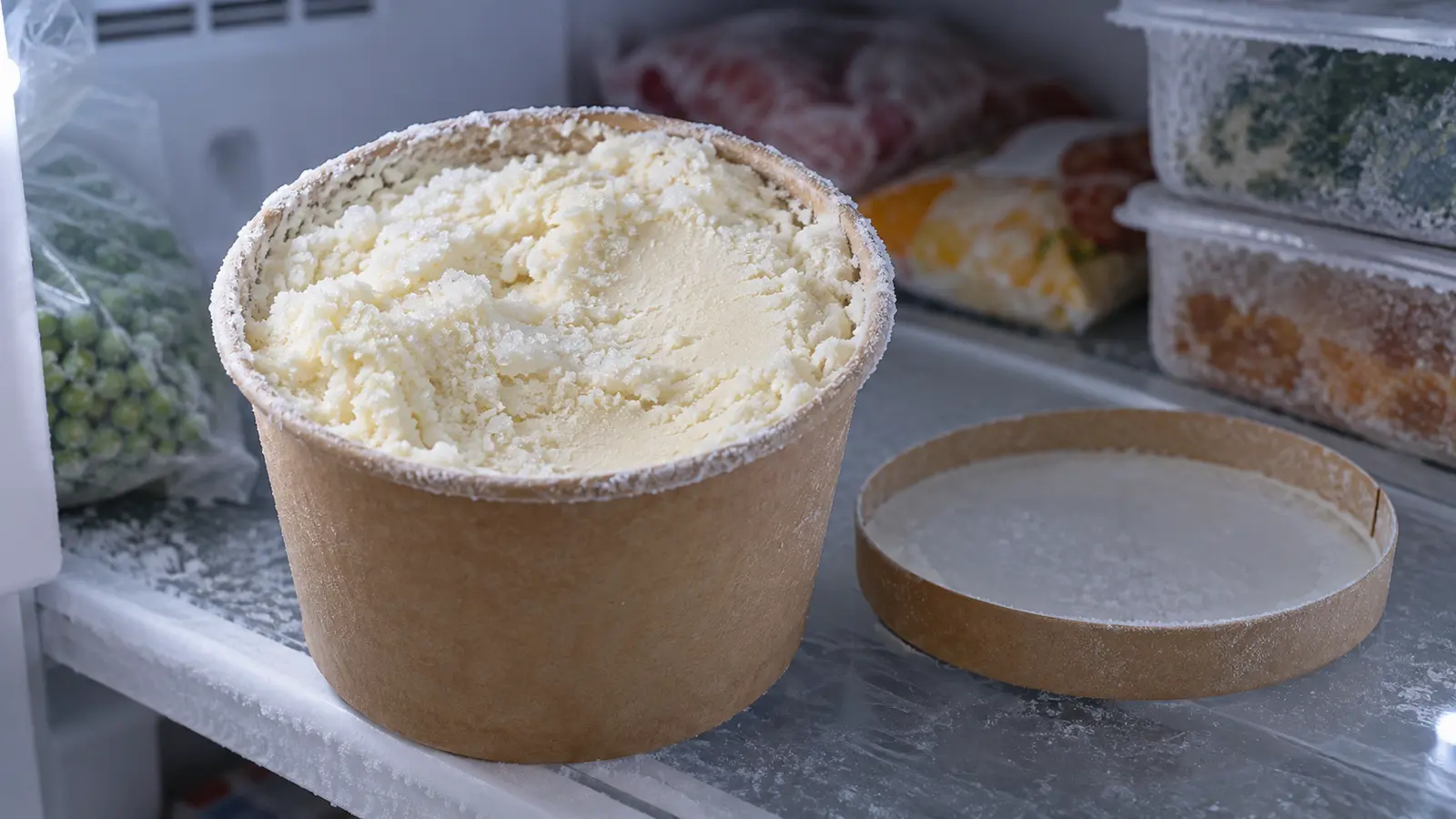
If you have wondered why does ice cream get icy even though it never left the freezer, the answer is that “frozen” is not a completely motionless state. Tiny amounts of ice can melt and refreeze as the temperature changes, allowing small crystals to disappear while larger crystals keep growing.
Fresh ice cream feels smooth because its ice crystals are extremely small and spread through a complicated mixture of concentrated syrup, fat, protein and air. Once those crystals become large enough for your tongue to detect individually, smooth dessert turns into something closer to sweet, grainy snow.
Ice Cream Is More Complicated Than Frozen Milk
Ice cream is a partly frozen foam and emulsion. Air bubbles are distributed through a liquid phase containing dissolved sugar and other ingredients, while fat droplets and proteins help support the structure. Only some of its water is frozen at normal serving temperature; the rest remains in a concentrated sugary solution.
That balance matters. Sugar lowers the freezing point, which is why ice cream remains scoopable rather than becoming a solid dairy brick. Churning introduces air and creates many small ice crystals, while rapid hardening limits how much time those first crystals have to grow.
The manufacturer is therefore trying to build a microscopic structure. The recipe controls sweetness and flavour, but it also controls how water freezes, how air is held and how quickly the product melts.
Small Crystals Gradually Become Bigger Ones
The damaging process is called ice recrystallisation. Water molecules move between existing crystals, changing their size and shape. Smaller crystals tend to shrink or melt while larger, more stable crystals gain water and grow. The total amount of ice may barely change, yet its distribution becomes much coarser.
Research on frozen storage consistently finds that warmer storage produces faster crystal growth. Very low, stable temperatures reduce molecular movement. A domestic freezer is nowhere near the ultra-low conditions used in some experiments, but the practical principle is the same: colder and steadier is better for texture.
Stabilisers such as guar gum, locust bean gum or carrageenan can slow the movement of water and make recrystallisation less dramatic. They do not make ice cream invincible. Even a carefully formulated product eventually becomes coarse if it spends enough time warming and cooling.
Temperature Swings Do Most of the Damage
Every time ice cream softens, a fraction of its smallest crystals melts. When the temperature falls again, that water does not neatly rebuild the original microscopic crystals. It migrates towards crystals that survived, making them larger.
This can happen while the tub sits on the kitchen counter, during a slow journey home from the shop or when a freezer repeatedly warms during defrost cycles. It also happens near the front of a freezer where opening the door produces sharper temperature changes. The back of the freezer generally offers a more stable home.
Repeated serving is a particularly effective texture-destruction system: remove tub, wrestle with hard surface, leave it out until scoopable, return softened remains, repeat. The ice cream may never visibly melt into liquid, but enough microscopic melting occurs to reorganise its crystals.
What About Frost and Air Exposure?
Air exposure creates a related problem. Moisture can leave the surface and redeposit as frost, especially when a loose lid allows cold, dry freezer air to circulate. This is part of the family of changes commonly called freezer burn. The exposed surface becomes dry or crusted while loose crystals collect around the lid and rim.
Surface frost is not necessarily the same as recrystallisation throughout the ice cream, but both are encouraged by poor temperature control and repeated opening. Pressing the lid on firmly, keeping the tub level and minimising empty air space with a suitable barrier can help protect quality.
How to Keep Ice Cream Smooth for Longer
Get it from the shop freezer to your own freezer quickly, ideally in an insulated bag during warm weather. Store it at about −18°C or colder and place it away from the door. Take out only what you need rather than allowing the entire tub to soften.
A scoop warmed briefly in water is kinder to the ice cream than waiting for the whole container to become soft. Replace the lid immediately and return the tub to the freezer. If the ice cream has genuinely started to defrost rather than merely becoming scoopable at the surface, UK food-safety guidance says it should not be refrozen.
None of this reverses existing large crystals. Once the structure has coarsened, blending may disguise it in a milkshake, but a colder freezer cannot shrink the crystals back to their factory size.
The Bottom Line
Ice cream gets icy because its microscopic structure changes during storage. Small crystals partly melt, water moves and larger crystals grow, particularly when the tub repeatedly warms and cools.
Keep it cold, keep it covered and keep its trips to the kitchen counter brief. Your freezer can preserve good texture, but it cannot perform cosmetic surgery on a tub that has been softened and refrozen six times.
FAQ
Is Icy Ice Cream Safe to Eat?
Short answer: A coarse texture alone is usually a quality issue. Ice cream that has actually defrosted should not be refrozen; follow the storage instructions on the packaging.
Why Is Ice Cream Icy Around the Lid?
Short answer: Warm air and a poor seal allow moisture to move, freeze and form surface frost around the top of the tub.
Can I Fix Crystallised Ice Cream?
Short answer: Not back to its original texture. The larger crystals remain, although using it in a blended dessert can make them less noticeable.
Further Reading
- Why Does Bread Go Stale? It Isn’t Simply Drying Out
- Why Do Fizzy Drinks Go Flat? The Carbon Dioxide Is Escaping
- Why Does Chocolate Turn White? It Usually Hasn’t Gone Mouldy
Sources
Effect of Frozen Storage Temperature on the Quality of Premium Ice Cream :: https://pmc.ncbi.nlm.nih.gov/articles/PMC4726959/
Recrystallization in Ice Cream After Constant and Cycling Temperature Storage Conditions :: https://www.journalofdairyscience.org/article/S0022-0302%2899%2975367-1/fulltext
Effect of Sweetener, Stabilizer, and Storage Temperature on Ice Recrystallization in Ice Cream :: https://www.journalofdairyscience.org/article/S0022-0302%2896%2976420-2/fulltext
Safer Food, Better Business: Chilling and Freezing :: https://www.food.gov.uk/sites/default/files/media/document/sfbb-chilling-04-freezing.pdf