
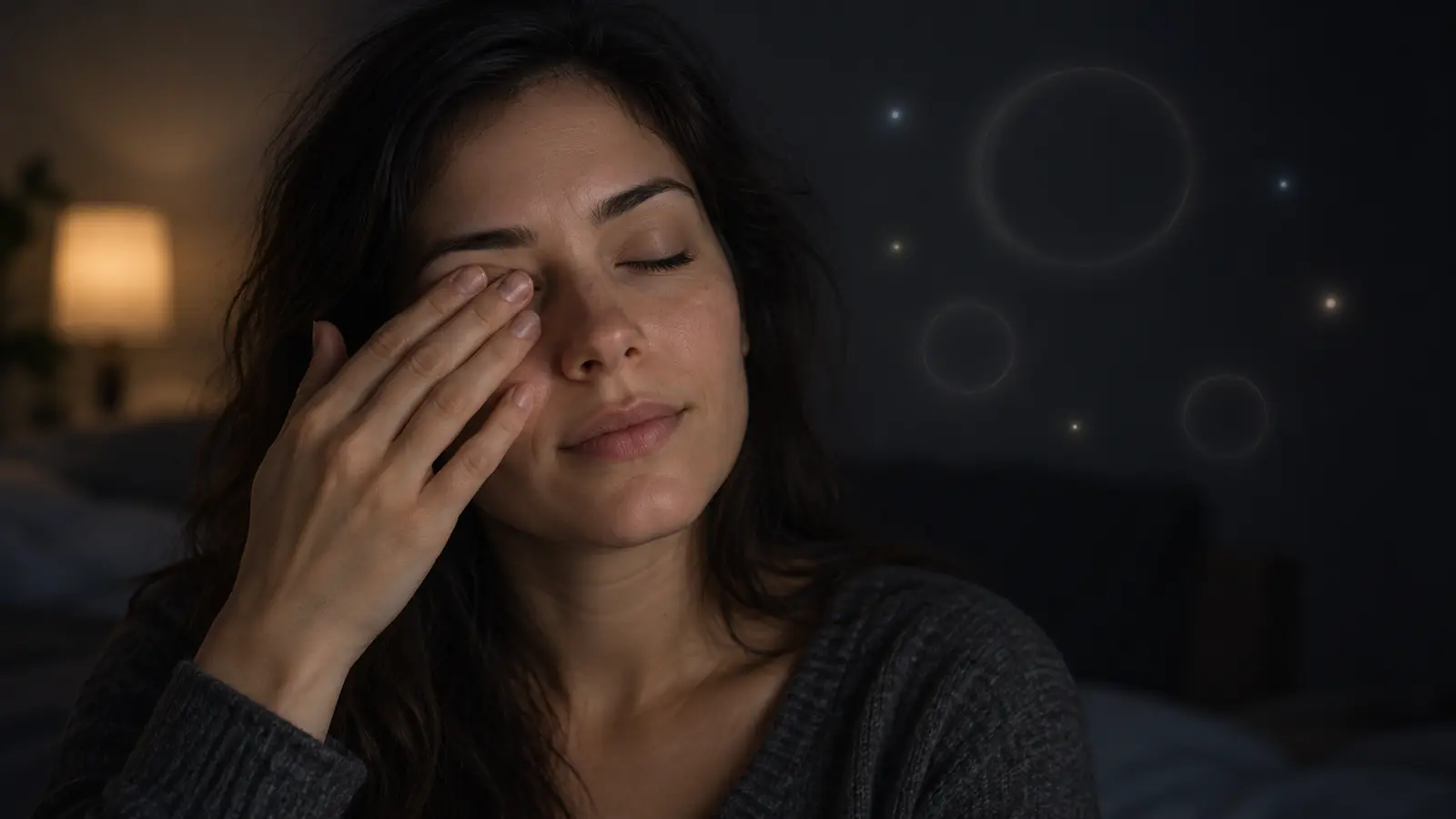
If you have wondered why do you see stars when you rub your eyes, the patterns are called phosphenes: perceptions of light produced without light entering the eye. Pressure slightly deforms the eyeball and mechanically stimulates cells in the retina. Your brain receives activity from the visual pathway and interprets it in the usual way—as flickers, spots, rings or glowing shapes.
Your Brain Does Not Receive a Picture
The retina is a layer of specialised nerve tissue lining the back of the eye. Photoreceptors normally respond to light and pass signals through retinal circuits to ganglion cells, whose fibres form the optic nerve. The brain constructs vision from those electrical messages; it does not have an independent window checking whether photons caused them.
If retinal cells or later parts of the visual pathway become active for another reason, the resulting sensation can still look like light. That is why electrical or magnetic stimulation can also produce phosphenes, and why people sometimes report flashes in situations where the room is completely dark.
Pressure Can Activate Retinal Cells
Rubbing a closed eyelid presses and shifts the eye beneath it. Research on pressure phosphenes describes how mechanical deformation can activate retinal ganglion cells and alter the signals leaving the retina. Different areas and patterns of pressure create different apparent shapes.
The perceived light may appear away from the point being pressed because the eye’s visual map is inverted. Pressing gently near one side of the eyeball can produce a glow on the opposite side of the visual field. Historic experiments documented these organised effects long before scientists could measure individual retinal cells.
Why Do the Patterns Look Like Stars?
“Seeing stars” is a convenient phrase, but phosphenes are not usually detailed five-pointed objects. People describe speckles, arcs, rings, grids, clouds, zigzags and moving coloured patches. The appearance reflects patterns of activity within retinal and brain circuits rather than the shape of something outside the eye.
Pressure is uneven and changes as a finger moves, so groups of cells are stimulated in shifting combinations. The visual system is also full of spontaneous electrical activity. In darkness, when there is little real visual input to compete with it, internally generated signals become easier to notice.
Why Are They Easier to See With Closed Eyes?
Closing the eyes reduces incoming light and creates a dark background. A small internally generated signal therefore produces greater contrast. The eyelid also makes it possible to transfer gentle pressure across the surface rather than touching the exposed cornea directly.
Phosphenes may linger briefly after the pressure stops because retinal and neural responses do not switch off like a perfect digital circuit. Adaptation and after-effects can make the pattern drift or fade over several seconds.
Other Ways Phosphenes Can Be Produced
Mechanical pressure is only one trigger. Electrical stimulation of the retina or optic nerve can create spots of light, a principle explored in visual prostheses. Transcranial magnetic stimulation over visual areas of the brain can also elicit phosphenes. Astronauts have described flashes associated with charged particles passing through the eye or visual system.
Migraine aura can include bright zigzags or shimmering blind spots, but it is not simply the same thing as rubbing an eye. Its patterns arise from activity in the nervous system and often develop across the visual field over minutes. The broad term “phosphene” describes a light sensation without an external light source; it does not give every flash the same cause.
Is Rubbing Your Eyes a Good Idea?
A brief, gentle rub is common, but pressing hard enough to create a light show is not a useful eye exercise. Repeated rubbing can irritate the eyelids and surface of the eye, worsen allergy-related inflammation and place unnecessary mechanical stress on the cornea. Clean hands also matter because rubbing transfers whatever is on the fingers towards the eye.
If an eye feels itchy, addressing dryness or allergy is more sensible than increasing pressure. Closing the eyes, blinking, using an appropriate lubricating drop or applying a cool compress may help, depending on the cause.
When “Seeing Stars” Is Something Else
The familiar pattern produced while deliberately rubbing both closed eyes has an obvious trigger and usually fades when you stop. Flashes that begin spontaneously are different information. New light streaks, a sudden shower of floaters or a shadow in the field of vision can accompany pulling on or damage to the retina and warrant prompt professional assessment.
A blow to the head can also cause stars because mechanical forces stimulate the visual system, but head-injury symptoms should not be dismissed as the same harmless experiment. Context matters: pressure phosphenes explain what happens during rubbing, not every unexplained flash.
The Bottom Line
You see stars when you rub your eyes because pressure mechanically stimulates the retina and creates signals in the visual pathway without incoming light. The brain interprets those signals as luminous patterns called phosphenes. It is a neat demonstration that vision is an electrical construction—but not a reason to press hard or repeatedly on delicate eyes.
FAQ
Are the stars caused by light entering through my eyelids?
Short answer: No. Pressure phosphenes can occur in complete darkness because mechanical stimulation, rather than external light, activates the visual pathway.
Why do I see colours as well as white flashes?
Short answer: Complex activity across retinal and brain circuits can be interpreted as different colours and patterns even without a matching external image.
Can rubbing your eyes damage them?
Short answer: Frequent or forceful rubbing can irritate the eye and stress the cornea, so deliberately pressing hard to produce phosphenes is best avoided.
Further Reading
- Why Do Mirrors Flip Left and Right but Not Up and Down? They Actually Don’t
- Why Do LED Lights Flicker on Camera? Your Eyes Usually Miss It
- Why Does Your Cat Stare at You? The Answer Depends on the Eyes
Sources
Phosphenes and the effects of charged particles on the visual system :: https://pmc.ncbi.nlm.nih.gov/articles/PMC12479296/
Purkyně’s description of pressure phosphenes and modern neurophysiological studies on the generation of phosphenes by eyeball deformation :: https://pubmed.ncbi.nlm.nih.gov/2531426/
Polymodal sensory integration in retinal ganglion cells :: https://pmc.ncbi.nlm.nih.gov/articles/PMC5111544/