
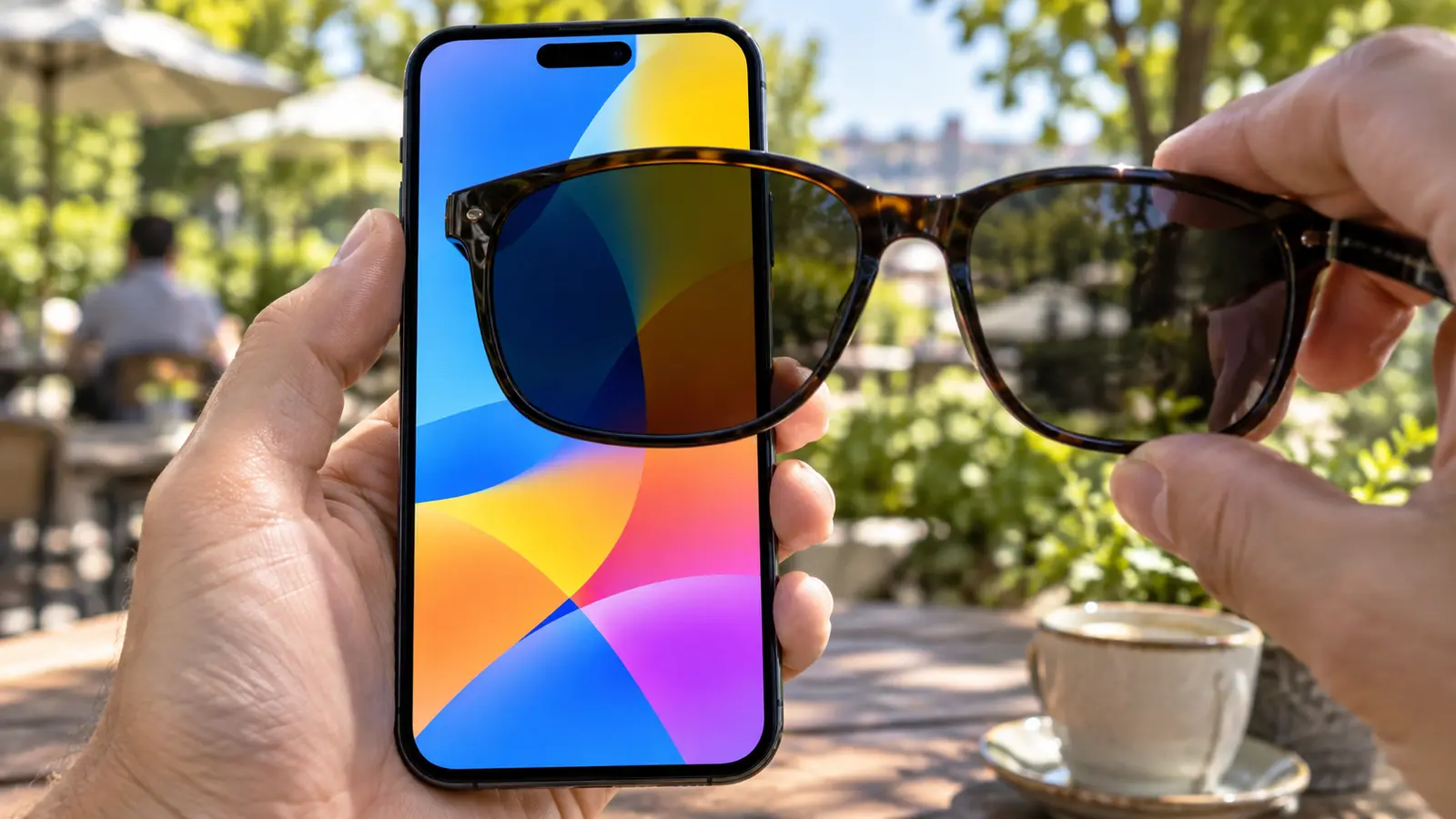
To answer why do screens go dark through polarised sunglasses, imagine placing two slatted filters on top of each other. When their openings line up, light passes; rotate one by 90 degrees and they block it. The real physics involves the direction of a light wave’s electric field rather than physical slats, but the outcome is similar: a polarised screen and polarised lenses can become crossed filters.
What Does Polarised Light Mean?
Light is an electromagnetic wave. Its electric field can oscillate in different directions perpendicular to the direction the light travels. Ordinary light from the Sun or a lamp contains a mixture of orientations. A linear polariser selectively transmits one orientation and absorbs much of the rest.
The filtering is not simply “vertical light good, horizontal light bad” in every situation. What matters is the transmission axis of the particular polariser and the orientation of the incoming light. Rotate the filter and the amount transmitted changes smoothly.
Why Sunglasses Use a Polarising Filter
Light reflected from broad horizontal surfaces such as water, wet roads and car bonnets is often strongly polarised in the horizontal direction. That reflected glare can be painfully bright and can hide detail. Polarised sunglasses are commonly arranged to reduce much of that horizontal component.
This makes water easier to see into and reduces dazzle while driving. It is separate from ultraviolet protection: a lens can block UV without being polarised, and a polarising filter does not replace proper UV filtering. Polarisation is mainly about managing directionally organised visible light.
LCD Screens Already Contain Polarisers
A liquid-crystal display uses polarisation to control brightness. In a simplified LCD, light from a backlight passes through a rear polariser, a liquid-crystal layer and a front polariser. Electrical signals change the orientation of liquid-crystal molecules at each pixel, altering how much the light’s polarisation rotates and therefore how much escapes through the final filter.
Colour filters divide pixels into red, green and blue components, but the light leaving the panel is still polarised. The screen has effectively performed one round of directional filtering before that light reaches your glasses.
Two Filters Can Cancel Each Other
Your sunglasses become an additional polariser. If their transmission axis lines up with the polarisation of the light leaving the display, much of that light passes. As the relative angle increases, the screen dims. Near a right angle, very little gets through and the display can appear black.
Malus’s law describes the ideal relationship: transmitted intensity varies with the square of the cosine of the angle between the incoming polarisation and the filter axis. You do not need the equation to see it. Look at a compatible screen through polarised glasses and rotate the device; brightness rises and falls with the angle.
Why Does Turning the Phone Fix It?
Rotating the phone changes the screen’s polarisation direction relative to the fixed axes of your lenses. A portrait display that looks fine may become very dark in landscape, or the reverse. Tilting your head has the same optical effect, although it is a less practical long-term viewing position.
Manufacturers can orient screen polarisers diagonally so that neither ordinary portrait nor landscape viewing is fully crossed with typical sunglasses. They may also use compensating films or different display structures. That is why two phones can behave differently through the same pair of glasses.
Why Do Some Screens Show Rainbow Colours?
Layers of glass, plastic, adhesives and protective cases can alter polarisation in ways that vary with wavelength and stress. Through polarised lenses, those differences may appear as rainbow patches, dark bands or colour shifts. Tempered glass screen protectors are common contributors because internal stress changes how they affect light.
The pattern does not necessarily mean that the screen or glasses are faulty. In fact, engineers and physics demonstrations use crossed polarisers to reveal stress in transparent materials that looks invisible under ordinary illumination.
What About OLED Screens?
OLED pixels produce their own light rather than modulating a separate backlight through the classic liquid-crystal sandwich. However, OLED devices can still contain circular polarisers and other optical films to reduce reflections and improve contrast. They may therefore dim, shift colour or show angle-dependent effects through polarised glasses, but not always in the same dramatic way as an LCD.
Dashboard, aircraft and marine displays deserve particular attention because readability is safety-critical. This is one reason pilots may be advised against polarised sunglasses: instruments, windscreens and reflections can behave unpredictably through them.
How Can You Make the Screen Easier to See?
First, rotate the phone or change its tilt. Increasing brightness and moving into shade can also help, though maximum brightness uses more battery and cannot defeat fully crossed filters. Removing a stressed screen protector may reduce rainbow patterns if that layer is the cause.
If a display must remain in one orientation—such as a car screen—the practical answer may be non-polarised sunglasses with good UV protection. The screen is not losing its image; your final optical filter is simply refusing to pass the light carrying it.
The Bottom Line
Screens go dark through polarised sunglasses when the light leaving the display is polarised in a direction that the lenses block. LCDs use polarising layers to form an image, and the sunglasses add another filter. Rotating the device or your head changes the relative angle, which is why the picture can suddenly return.
FAQ
Does a dark screen mean my sunglasses are genuine?
Short answer: It is evidence that the lenses are polarising some light, but screen behaviour alone does not establish lens quality or UV protection.
Why does only one screen turn black?
Short answer: Displays use different polariser orientations and optical stacks, so the same sunglasses may cross one screen’s axis but not another’s.
Can polarised sunglasses damage a screen?
Short answer: No. They only filter the light travelling from the display to your eyes; they do not alter the screen itself.
Further Reading
- Why Do Mirrors Flip Left and Right but Not Up and Down? They Actually Don’t
- Why Do LED Lights Flicker on Camera? Your Eyes Usually Miss It
- Why Does Your Voice Sound So Weird in Recordings? There’s a Physical Reason
Sources
Magic Glasses: The Physics of an LCD :: https://www.memphis.edu/physics/demonstrations/magic_glasses.php
Malus’ Law :: https://sciencedemonstrations.fas.harvard.edu/presentations/malus-law
Polarization: Crossed Polaroids :: https://instructional-resources.physics.uiowa.edu/6h1010-polarization-crossed-polaroids