
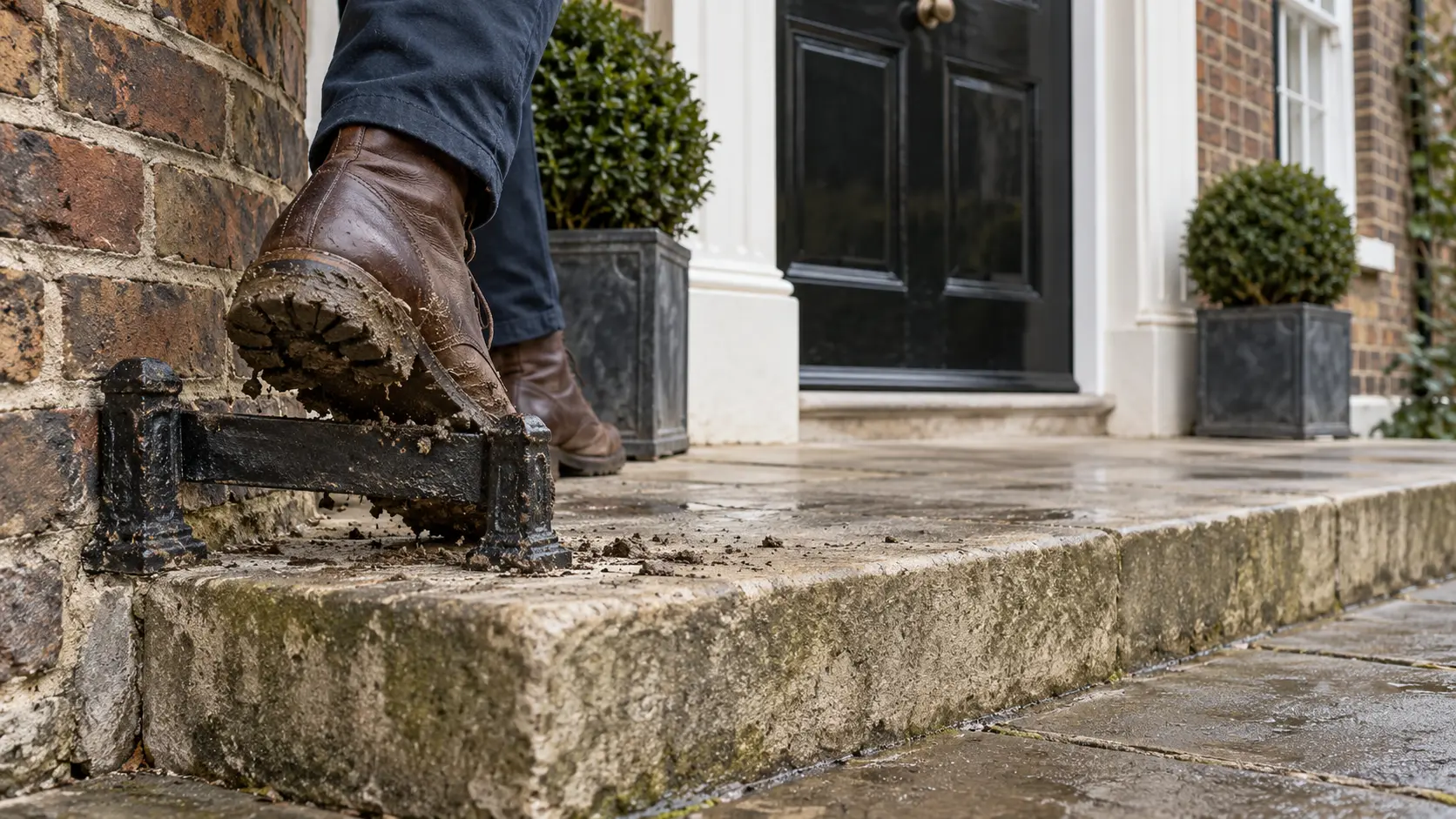
Why Did Old Houses Have Boot Scrapers? Because the street outside was often a mixture of mud, dust, animal waste, and whatever else urban life had failed to remove. Before entering, visitors dragged the soles and edges of their boots across an iron blade fixed beside the door.
The scraper removed the worst of the mess before it reached carpets, floorboards, and servants armed with increasingly justified resentment. Thousands still survive in railings, stone steps, and small recesses beside Georgian and Victorian entrances.
Streets Were Built Around Horses
For centuries, horses provided much of the power for personal travel, freight, public transport, military movement, and street services. A busy town contained riding horses, private carriages, delivery carts, cabs, omnibuses, and animals moving goods to and from markets.
Every horse produced manure and urine throughout the working day. Add unpaved or poorly drained roads, rain, spilled cargo, coal dust, and domestic waste, and the result clung enthusiastically to footwear.
Street cleaning improved during the nineteenth century, with mechanical sweepers and organised sanitation, but it did not make the problem vanish. A respectable front door still needed a defensive line.
What a Boot Scraper Looked Like
The simplest scraper was a horizontal iron bar or upright blade anchored into stone. A person placed one foot against it and pulled the boot backwards, scraping material from the sole, heel, and edges.
Some were built into iron railings. Others sat inside a small stone niche beside the steps, which helped contain the debris and made the device less likely to catch a passing skirt or ankle. More elaborate examples used decorative cast iron shaped to match the architecture.
They were not brushes and did not leave footwear polished. Their job was to remove the thick layer that nobody wanted introduced to the hallway.
Why They Sit Beside Basement Steps
Many Georgian and Victorian townhouses had a raised main entrance above a lower service level. Railings surrounded the open basement area, providing a natural place to incorporate a scraper close to the front step.
Servants, deliveries, and tradespeople might use the lower entrance, while residents and guests approached the main door. Scrapers could appear at either route because mud did not observe social hierarchy.
On some streets, only the slot or recess remains. The iron fitting was removed for scrap, corroded away, or disappeared during alterations, leaving a mysterious architectural hole whose original purpose is easily missed.
They Were Useful Beyond Cities
Country houses, churches, inns, schools, and farm buildings also used boot scrapers. Rural roads and paths supplied ordinary mud in heroic quantities, while farms added their own specialised ingredients.
A scraper outside a church made particular sense. People might walk across unpaved lanes and churchyards in their best clothes, then gather inside a building where dirty floors were difficult to clean. The same logic applied to any public building receiving many booted visitors.
Why Not Just Use a Doormat?
Doormats are good at dust, light dirt, and moisture. They are much less effective against a thick ridge of compacted mud lodged around a boot heel.
The iron edge broke away the heavy material first. A mat, brush, or servant with cleaning equipment could deal with what remained. In practical terms, the scraper was the coarse stage of a two-step cleaning system.
Some entrances also had gratings or areas where debris could fall below foot level. Design was doing the dirty work before anyone had invented a lifestyle catalogue around it.
Why Did Boot Scrapers Disappear?
Roads became better paved and drained. Municipal cleaning expanded, sewerage improved, and motor vehicles gradually displaced urban horses. Footwear also changed, and rubber soles held different kinds of dirt from deeply treaded or nailed boots.
Indoor cleaning became easier with modern flooring and vacuum cleaners. By the twentieth century, a fixed iron blade at every doorway was less necessary and could be treated as an obstruction.
Many were removed during wartime scrap drives or later building work. Those that remain are small fossils of an infrastructure designed for a city powered by animals.
The form and position of a surviving scraper can also reveal how an entrance was used. A fitting beside a basement doorway may mark the service route, while a decorative example by grand front steps was intended for residents and guests.
The Bottom Line
Old houses had boot scrapers because streets were far dirtier than modern pavements. Mud, horse manure, and road debris collected on heavy boots, and an iron blade removed the worst before anyone stepped indoors. The surviving scrapers are humble evidence of how much the front door once had to defend.
FAQ
What are the iron bars beside old front doors?
Many are boot scrapers. Users dragged muddy soles across the edge before entering the building.
Were boot scrapers only Victorian?
No. They existed before and after the Victorian period, although many surviving urban examples are associated with Georgian and nineteenth-century buildings.
Why are some boot scrapers set into a wall recess?
The recess kept scraped dirt contained and reduced the risk of the iron fitting obstructing the steps or pavement.
Sources
Boot Scraper — The Henry Ford Collections :: https://www.thehenryford.org/collections/explore/artifact/487158
Model of street-sweeping machine :: https://collection.sciencemuseumgroup.org.uk/objects/co48530/model-of-street-sweeping-machine
A Day in the Life of Early Williamsburg’s Horses :: https://www.colonialwilliamsburg.org/discover/daily-life/horses/