
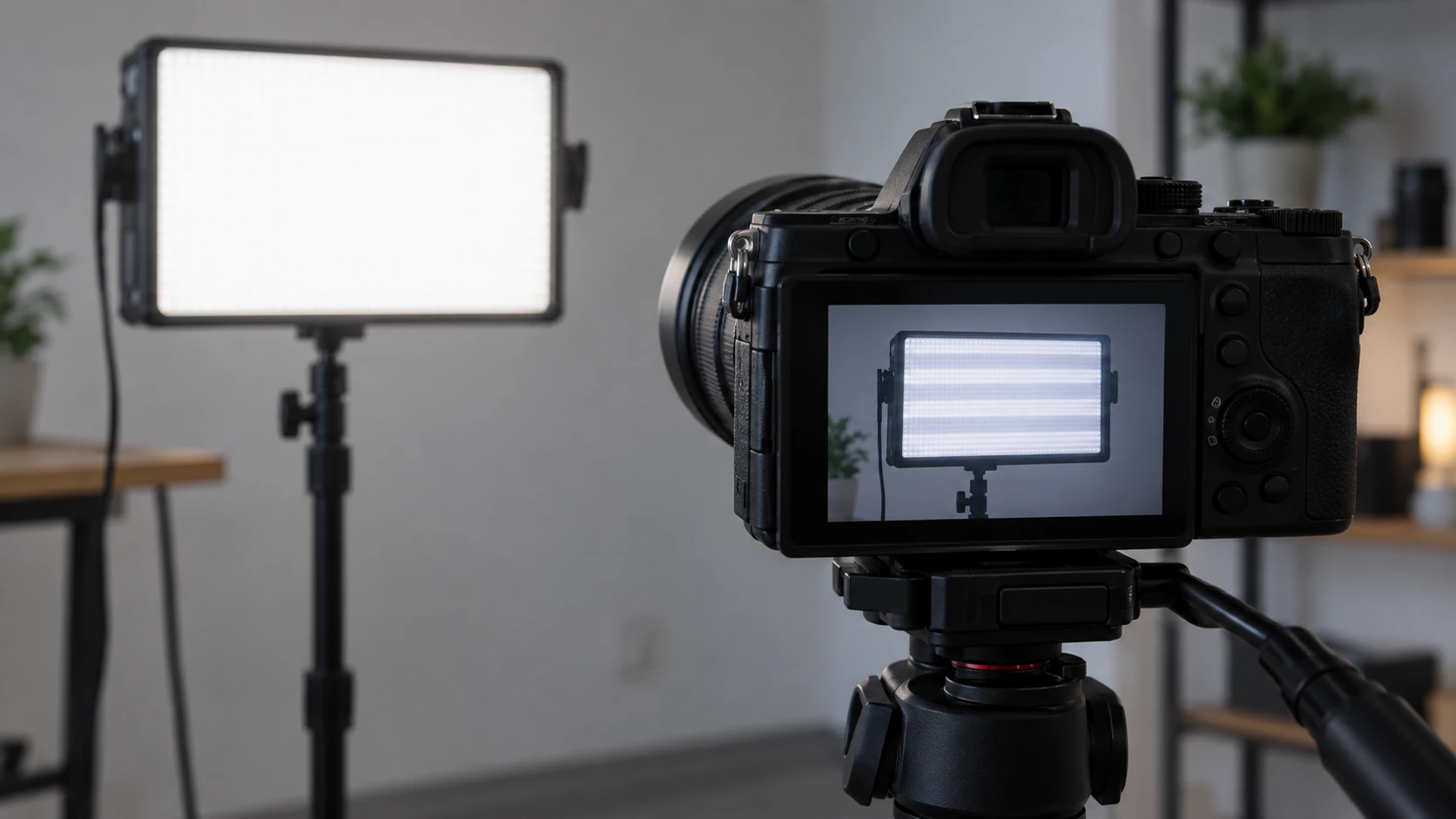
Why Do LED Lights Flicker on Camera when the same room looks perfectly steady to your eyes? Because “steady” light is not always steady at all. Some LED systems change their output rapidly — often hundreds or thousands of times per second — and your visual system may smooth that into apparently continuous illumination.
A camera does something different. It records light during precise slices of time, and many sensors do not capture the whole image at exactly the same instant. If the LED’s brightness cycle and the camera’s shutter timing do not line up, the recording can reveal dark bands, pulsing or changing brightness that you never noticed while standing in the room.
LEDs Can Respond Almost Instantly
An old incandescent bulb has a hot filament. Even as the electrical supply changes through the mains cycle, the filament does not instantly become cold and dark. Its heat gives the light a degree of persistence.
LEDs behave differently. The light-emitting device can respond extremely quickly to changes in the current supplied by its driver electronics. The US Department of Energy describes this changing output as temporal light modulation.
Good LED drivers can keep the output very stable. Other designs allow the brightness to rise and fall much more noticeably. So “LEDs flicker” is not a universal rule: some systems exhibit very little modulation, while others can vary dramatically.
Dimming Can Make the Effect More Obvious
One common way to control LED brightness is pulse-width modulation, or PWM. Instead of making the LED glow weakly all the time, the electronics switch it on and off rapidly and alter the proportion of each cycle spent on.
If the switching is fast enough, you may perceive only the average brightness. A camera can still catch individual parts of that cycle.
Other driver designs also create repeating changes in output linked to the electrical supply or the internal power electronics. That is why two LED lamps that look identical to a person can behave very differently on video.
Your Eyes and a Camera Do Not Sample Light the Same Way
Human vision is not a high-speed light meter taking one isolated measurement after another. The eye and brain integrate rapidly changing information over time, so high-frequency modulation may become difficult or impossible to perceive directly.
A camera has an exposure time. It opens its shutter — physically or electronically — for a specific interval and records whatever light arrives during that period.
If one frame catches an LED during a brighter part of its cycle and the next catches a darker part, the recorded image can pulse. If different parts of the sensor are exposed at slightly different times, the result can be horizontal or vertical bands rather than the entire image simply becoming brighter and darker together.
The Shutter Is Where Things Get Weird
Sony’s explanation of camera flicker describes how a focal-plane shutter exposes different positions on the sensor at different moments. Under a rapidly changing light source, one part of the frame can therefore receive more light than another.
Electronic shutters and rolling-shutter sensors can create a similar timing problem because the image is effectively read line by line. The light can complete part of a brightness cycle while the camera is still working its way across the frame.
The result is the familiar stack of dark and bright stripes seen when filming some LED lamps, screens or illuminated signs.
Why Shutter Speed Can Fix It
The easiest fix is often to change the shutter speed so the exposure averages over a more suitable number of lighting cycles.
In countries with 50 Hz mains electricity, camera manufacturers commonly recommend shutter speeds such as 1/50 or 1/100 second for conventional mains-related flicker. In 60 Hz regions, 1/60 or 1/120 second is the equivalent starting point.
High-frequency LED lighting can be trickier because its modulation does not necessarily match the mains frequency neatly. Some cameras therefore offer variable-shutter or high-frequency anti-flicker settings that allow much finer adjustment until the banding disappears.
Why Your Phone Can Show It Too
You do not need a professional camera to reveal the effect. Smartphone cameras also use electronic sensors and rolling readout, so they can show bands when pointed at certain lamps, monitors, LED signs or vehicle lights.
Slow-motion video is particularly good at exposing rapidly changing light because it records far more frames per second. Something that appeared completely stable in real life can suddenly pulse dramatically.
This is also why filming a screen can produce patterns that were not visible to the person holding the phone. Two electronic timing systems — the display and the camera — are interacting.
It Does Not Mean the Light Is Broken
Camera-visible flicker is often a timing effect rather than evidence of a faulty lamp. Sony explicitly notes that banding or colour changes under LED and fluorescent lighting can be normal camera behaviour.
Likewise, a light that appears steady on one camera may flicker on another because the shutter speed, frame rate and sensor readout are different.
The useful mental model is simple: the light is changing over time, the camera is sampling it over time, and occasionally those two clocks disagree in a very visible way.
The Bottom Line
LED lights can flicker on camera because some LED drivers vary light output extremely quickly, while cameras record that output in precisely timed exposures. Your eyes may smooth the changes into continuous light, but the camera can freeze or slice the cycle into visible bands.
Changing shutter speed or using an anti-flicker setting often solves the problem. The lamp did not suddenly start misbehaving when you pressed record; the camera simply caught something your eyes were happily ignoring.
FAQ
Why Do LED Lights Flicker on Camera?
Short answer: The LED’s light output can vary rapidly, and the camera’s shutter or sensor may sample different parts of that cycle.
Why Can’t I See the Flicker With My Eyes?
Short answer: Rapid changes can be too fast for normal direct perception, so your visual system experiences the light as effectively steady.
Why Does LED Flicker Appear as Dark Bands?
Short answer: Different parts of the image sensor can be exposed at different moments while the LED’s brightness is changing.
Can Changing Shutter Speed Remove LED Flicker?
Short answer: Often, yes. Matching or fine-tuning shutter timing can reduce or remove visible banding and pulsing.
Sources
Flicker Basics :: https://www.energy.gov/cmei/ssl/flicker-basics
Flicker Research :: https://www.energy.gov/cmei/ssl/flicker-research
How to Reduce Camera Flickering :: https://www.sony.com/electronics/support/camcorders-and-video-cameras-hard-drive-camcorders/articles/00122281
Part or All of the Image May Change Color, Showing Banding or Flickering :: https://www.sony.com/electronics/support/articles/00008839