
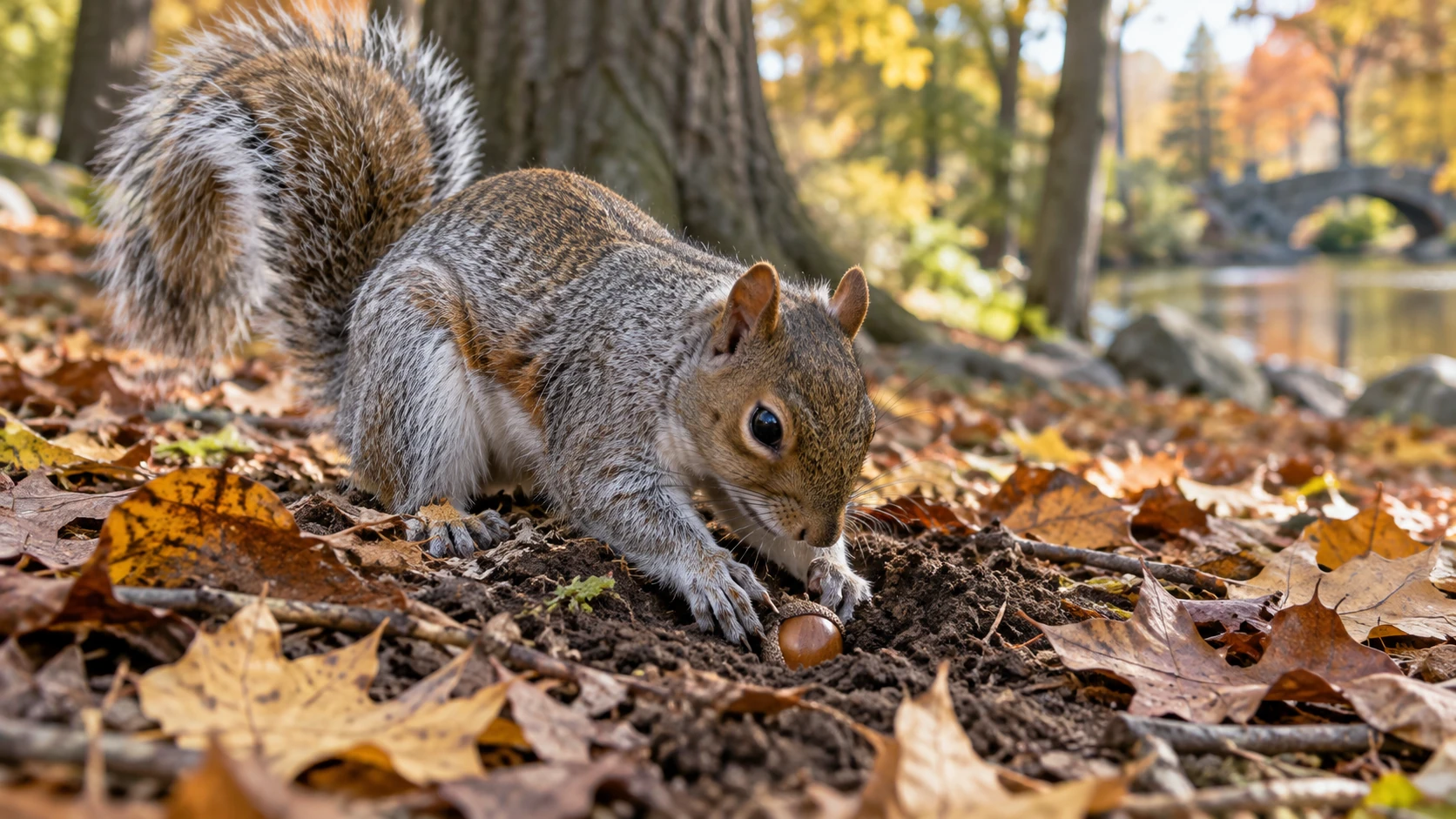
Why Do Squirrels Bury Nuts instead of simply keeping one enormous pile somewhere convenient? Because one enormous pile would also be extremely convenient for every other hungry squirrel. Many tree squirrels use a strategy called scatter hoarding: they distribute food across lots of separate hiding places and return to those caches later.
The surprising part is how sophisticated that system can be. Squirrels do not merely bury food at random and hope for the best. Research shows that they assess food quality, adjust how much effort they invest in a cache, use spatial memory, and can even organise different types of nuts into separate areas. Some caches are inevitably lost, stolen or left behind — which is excellent news for certain trees.
One Nut per Hiding Place Spreads the Risk
Food hoarding exists on a spectrum. Some animals create a concentrated “larder”, while scatter hoarders spread food across many small caches.
For a squirrel, scattering has an obvious advantage. If another animal finds one buried nut, the thief has found one meal rather than the entire winter reserve. The downside is administrative: the squirrel now has a large number of locations to manage.
That trade-off makes sense in a competitive environment. Other squirrels can watch, investigate and steal caches, so hiding food is not just about saving it for later. It is also about making the stash difficult for competitors to wipe out in one go.
Squirrels Actually Remember Where They Put Things
The old cartoon version of a squirrel burying hundreds of nuts and then forgetting all of them is much too simple.
Experiments with grey squirrels have shown that they recover their own caches more successfully than caches made by other squirrels, even when the sites are close together. That indicates genuine memory for cache locations rather than a strategy based only on sniffing around until a nut turns up.
Smell still matters. Squirrels can use odour when searching, and the two systems are not mutually exclusive. A sensible strategy is to use spatial memory and landmarks to get close to the right area, then use smell for the final search.
The Cache Map Can Be Surprisingly Organised
Research on fox squirrels at the University of California, Berkeley found evidence of a memory strategy known as “spatial chunking”. Given different kinds of nuts, squirrels sometimes stored each type in its own spatial cluster.
Think of it as creating folders rather than dumping every file onto the desktop. If walnuts tend to be in one area and hazelnuts in another, the animal may reduce the mental workload involved in managing thousands of stored items.
The behaviour was flexible rather than rigid. How squirrels organised caches changed depending on how the food was presented, suggesting that this is an active strategy rather than a simple automatic rule.
Not Every Nut Is Treated Equally
Squirrels also spend more effort on some food than others. Berkeley research on fox squirrels found that cache decisions changed with food value and scarcity. Animals assessed nuts before deciding whether to eat them, carry them away or invest effort in hiding them.
That makes economic sense. Carrying a nut, finding a site, digging, burying it and disguising the disturbed ground all cost time and energy. A better item can justify more investment.
Competition matters too. A squirrel that thinks it has been watched may behave differently around a cache because the value of a perfect hiding place drops sharply if another squirrel already knows where it is.
So Why Do Some Buried Nuts Never Come Back?
Because successful scatter hoarding does not require perfect recovery. Caches can be stolen, moved, eaten by other animals, abandoned, forgotten, or simply become unnecessary if food remains plentiful.
Studies of scatter-hoarding systems show that seeds which escape recovery can survive underground and germinate. Recent work on fox squirrels and oaks, for example, found that squirrels can move high-quality acorns away from parent trees and create patterns of dispersal that support oak recruitment.
So the familiar idea that “squirrels plant forests by forgetting nuts” contains a useful truth, but the forgetting part should not be overplayed. The ecological effect comes from seeds escaping consumption for any number of reasons, while the squirrel’s actual memory can be impressively good.
Burying Is Good for Trees — Sometimes
From the tree’s point of view, a squirrel is both predator and delivery service. It eats plenty of seeds, which is obviously bad news for those individual seeds. But it also transports others away from the parent plant and buries them in soil, which can create good conditions for germination.
Whether that relationship is beneficial overall depends on the species, habitat and what eventually happens to the cache. Ecology rarely gives us the satisfying simplicity of “squirrel forgets acorn, tree appears”.
What it does give us is a neat partnership created by conflicting interests: the squirrel is trying to save lunch, while the oak only needs a few lunches to escape.
The Bottom Line
Squirrels bury nuts to store food while spreading the risk of theft across many separate caches. They use memory, landmarks, smell and flexible caching strategies to manage those stores.
Some buried seeds inevitably escape recovery and can grow, which makes scatter-hoarding squirrels important seed dispersers. The funny part is that their accidental gardening works not because squirrels have terrible memories, but despite the fact that their memories are rather good.
FAQ
Why Do Squirrels Bury Nuts?
Short answer: They are storing food for later while reducing the risk that one thief can steal the entire supply.
Do Squirrels Remember Where They Bury Nuts?
Short answer: Yes. Research shows that squirrels can remember specific cache locations, although they also use smell and other cues.
Do Squirrels Organise Their Nut Caches?
Short answer: They can. Fox squirrels have been observed grouping different types of nuts into separate spatial clusters.
Do Forgotten Nuts Really Grow Into Trees?
Short answer: Some unrecovered cached seeds do survive and germinate, so scatter-hoarding can contribute to seed dispersal and forest regeneration.
Sources
Squirrel Economics — Jacobs Lab of Cognitive Biology :: https://jacobs.berkeley.edu/project/sql-econ/
Fox Squirrels Use ‘Chunking’ to Organize Their Favorite Nuts :: https://news.berkeley.edu/2017/09/12/nut-chunking/
Grey Squirrels Remember the Locations of Buried Nuts :: https://jacobs.berkeley.edu/wp-content/uploads/2015/10/Animal-Behaviour-1991-Jacobs.pdf
Tree Squirrels Selectively Disperse High-Quality Acorns Away From Tree Trunks :: https://pubmed.ncbi.nlm.nih.gov/42490413/