
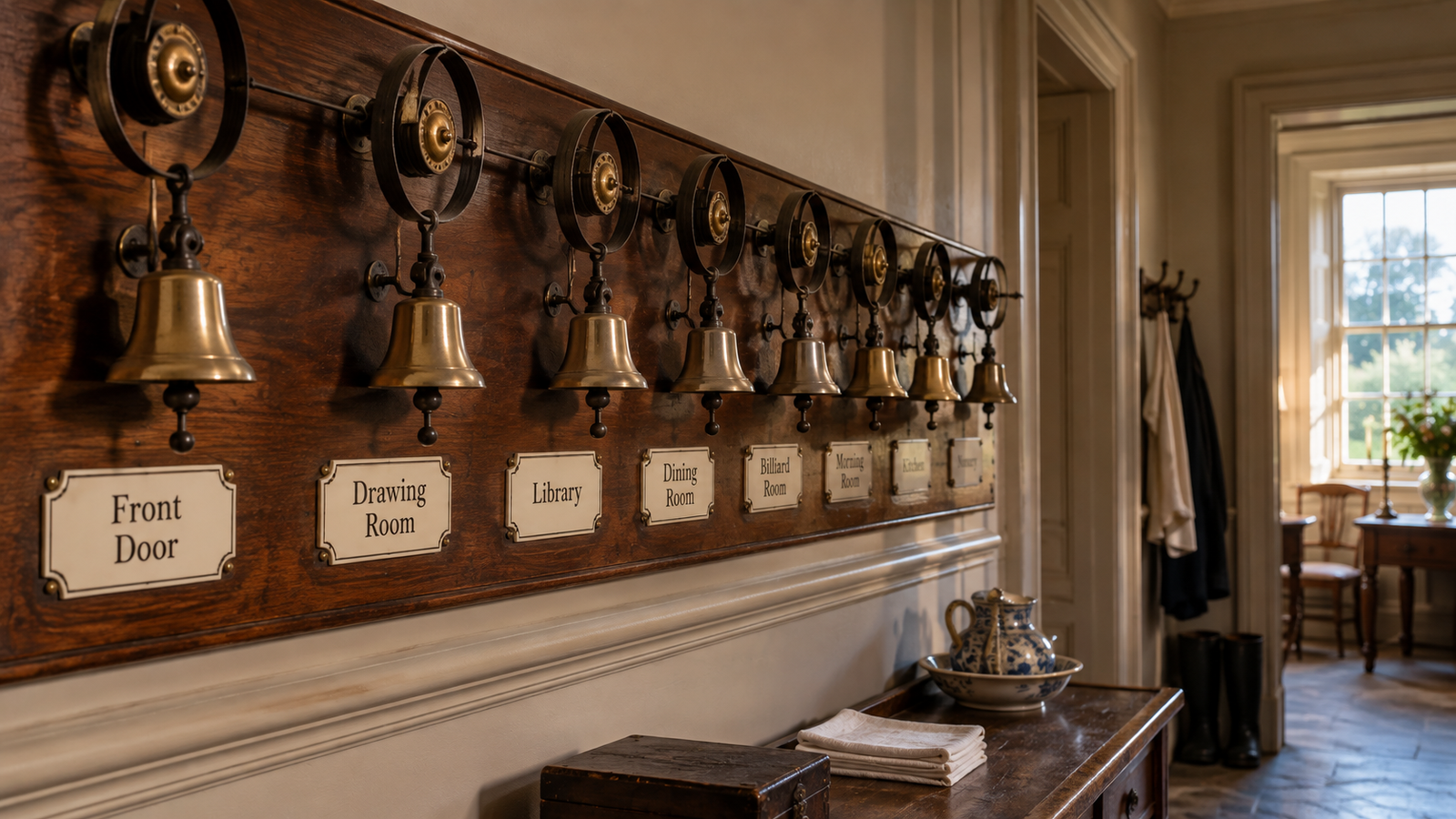
Spend enough time wandering around a British stately home and you will eventually encounter a wall that looks like somebody attempted to build an extremely low-budget Victorian alarm system.
Rows of brass bells.
Little labels underneath them.
Drawing Room.
Bedroom.
Library.
Dressing Room.
Sometimes dozens of them.
They were not decoration.
Each bell was part of an elaborate communication network running through the house.
Pull a cord upstairs and, somewhere far away, a bell rang to summon a servant.
It was basically the Georgian version of pressing a notification button.
Large Houses Created a Communication Problem
Earlier manor houses were generally more communal places.
Servants and employers occupied overlapping spaces, and service areas could sit relatively close to the main household.
That gradually changed.
From the eighteenth century onwards, large country houses increasingly separated servants from the wealthy families they worked for.
Kitchens, laundries, pantries, servants’ halls, bedrooms, corridors, and sometimes entire service wings were designed to keep the machinery of domestic life conveniently out of sight.
Wonderful for the person who did not want to see anybody carrying coal through the drawing room.
Slightly less convenient when that person suddenly wanted hot water.
The solution was a network of bells.
Pull Here, Ring Somewhere Else
Early systems were mechanical.
A cord, handle, or decorative pull in one room connected through a surprisingly elaborate route of wires to a bell elsewhere in the house.
Pull the handle and tension travelled through the wire.
The bell rang.
In bedrooms, pulls could be positioned beside the bed so somebody could summon assistance without even getting up.
Because apparently walking downstairs to ask for breakfast was not part of the lifestyle.
The Wires Could Run Remarkable Distances
Connecting a room to a distant service area was not as simple as tying string between two doors.
Wires had to travel around corners, along walls, above ceilings, through floors, and across substantial buildings.
Small cranks and pivots changed the direction of the pull.
The finished installation could become an impressive piece of mechanical engineering hidden almost entirely from view.
At Audley End House, English Heritage records mechanical servant-bell systems dating from the 1760s, among the earliest well-documented examples.
The visible bell was only the final part of a network stretching back through the building.
How Did Servants Know Which Bell Rang?
This is the clever bit.
The bells were mounted together and labelled according to the rooms they served.
But imagine several bells ringing while you were somewhere else.
By the time you arrived, they would all be silent.
So many servant bells were mounted on coiled springs.
When triggered, a bell did not simply ring and instantly stop moving.
It continued to oscillate afterwards.
A servant entering the area could look at the row and see which bell was still moving.
The movement acted as a primitive notification history.
Your phone leaves a little badge beside an app.
A Georgian mansion left one brass bell wobbling.
Different Bells Could Sound Different Too
Bells could vary in size and tone.
Experienced household staff could potentially recognise which one had rung without needing to inspect the labels.
That mattered in large homes where requests could arrive frequently throughout the day.
The bell did not explain what the employer wanted.
It merely told a servant where they were required.
You still had to walk all the way there to discover whether the crisis involved a visitor, a missing handkerchief, another lump of coal, or the catastrophic absence of tea.
Then Electricity Arrived
Mechanical bell systems were eventually joined by electrical versions.
By the second half of the nineteenth century, electric bells became practical in wealthy homes.
Instead of physically pulling a long wire all the way through the building, pressing a button could complete an electrical circuit.
Indicator boards then showed which room had called.
A bell sounded to attract attention, while a coloured marker or numbered indicator identified the source.
It was essentially the same basic concept as a modern hotel call system.
Only with substantially more domestic hierarchy.
Speaking Tubes Were the Next Upgrade
Servant bells had one obvious flaw.
They transmitted only one piece of information:
COME HERE.
The servant still had to travel to the room to find out why.
Speaking tubes improved matters.
These were physical tubes running between different parts of a building.
A person could speak into a mouthpiece and their voice travelled through the tube to the other end.
Some systems used whistles or plugs to attract the recipient’s attention.
Now the message could effectively become:
COME HERE, AND BRING TEA.
Civilisation marches forward.
Then the Telephone Took Over
Internal telephone systems eventually made both bells and speaking tubes increasingly obsolete.
By the late nineteenth and early twentieth centuries, wealthy homes could install telephones connecting different rooms and service areas.
The house had essentially evolved from mechanical notification, to basic signalling, to voice communication.
Which is exactly the same technological progression we continue repeating in newer forms.
Why Are Servant Bells Still in Historic Houses?
Because removing them was not always necessary.
Once obsolete, many systems were simply left in place.
Wires disappeared behind later decoration, but bell boards survived in servants’ halls, corridors, and service areas.
Today, they provide unusually tangible evidence of how large households actually functioned.
A grand drawing room tells you how the owners wanted to live.
A wall of servant bells tells you how many other people were required to make that lifestyle possible.
The Technology Also Reveals the Social Structure
The bells are interesting gadgets.
They are also physical evidence of class hierarchy.
As servants were moved into less visible parts of wealthy homes, technology allowed employers to keep those workers out of sight while still having immediate access to their labour.
The system made the house more convenient for one group by making another group permanently callable.
That does not make the technology less ingenious.
It simply explains why it existed.
Domestic convenience and social structure were wired together rather literally.
The Bottom Line
Old houses had rows of servant bells because large wealthy households needed a way to communicate across increasingly separated living and service areas.
Mechanical wires connected bell pulls in family rooms to labelled bells near the servants.
The bells could keep moving after they rang, revealing which room had called.
Later systems became electrical, followed by speaking tubes and internal telephones.
So that mysterious wall of little brass bells was not decoration.
It was a household notification centre.
Two centuries before anyone complained about having too many apps sending alerts.
FAQ
How did Victorian servant bells work?
A pull or lever in a room operated wires running through the building to a bell in the servants’ area.
How did servants know which room was calling?
Each bell corresponded to a particular room and was normally labelled. Many remained visibly moving for a short period after ringing.
Were servant bells only Victorian?
No. Mechanical systems were in use during the 18th century, well before the Victorian era, although they remained common in large Victorian households.
When were electric servant bells introduced?
Electrical systems began appearing during the 19th century as battery and electrical technology became practical for domestic use.
What replaced servant bells?
Speaking tubes and internal telephone systems provided more direct communication, while changing domestic-service patterns eventually reduced the need for such systems altogether.
Sources
Country House Communication Through the Ages :: https://www.nationaltrust.org.uk/discover/history/art-collections/country-house-communication-through-the-ages
Pioneering Country House Technology at Audley End :: https://www.english-heritage.org.uk/visit/places/audley-end-house-and-gardens/history-and-stories/country-house-technology/
Technology in the Country House :: https://historicengland.org.uk/images-books/publications/technology-in-the-country-house/