
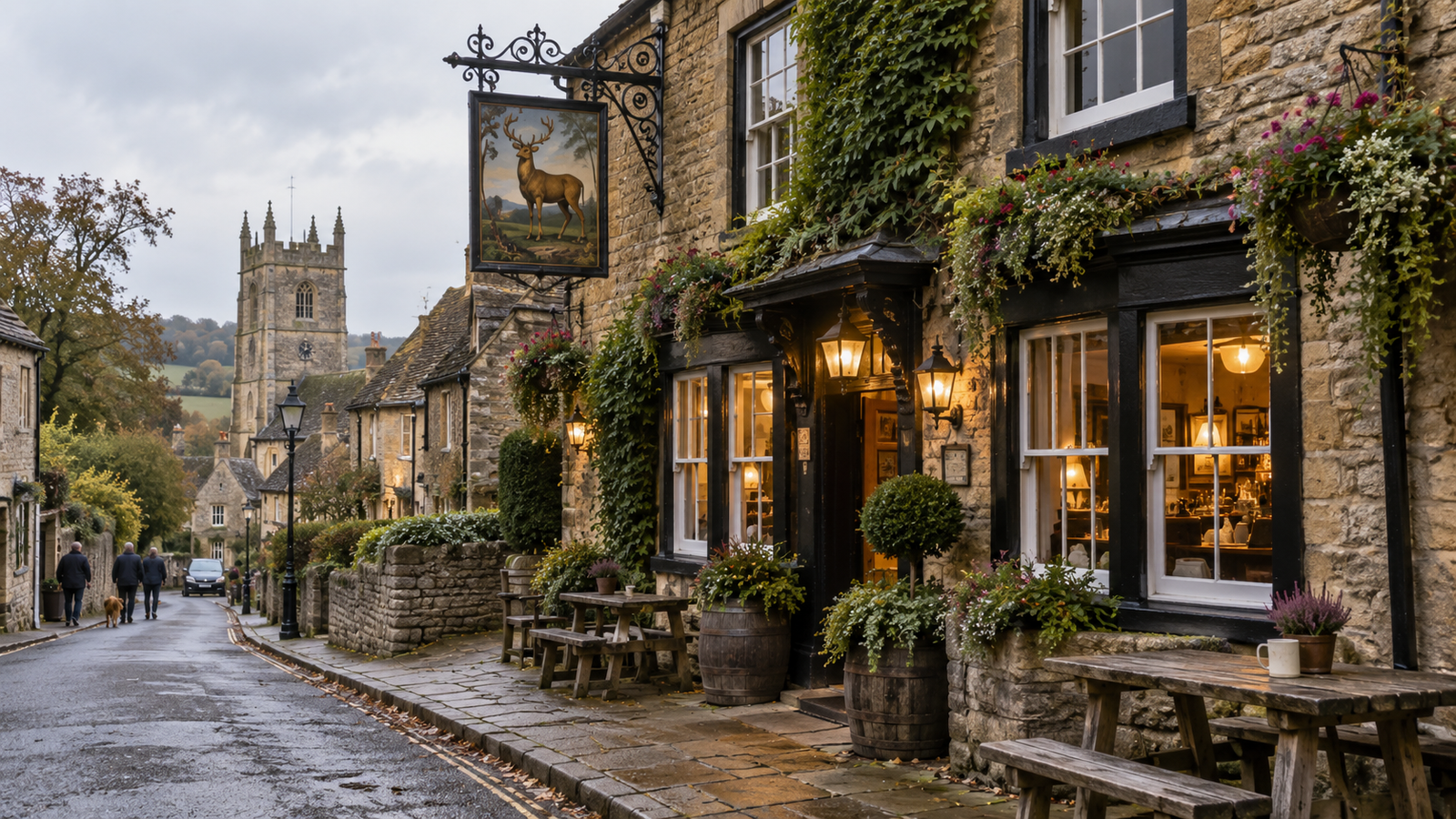
Britain has thousands of pubs, yet for several centuries apparently nobody involved in naming them felt obliged to make sense.
The Red Lion.
The White Hart.
The King’s Arms.
The Three Horseshoes.
The Swan With Two Necks.
Walk through almost any British town and you will eventually encounter a pub whose name sounds as though somebody selected three random words from a medieval hat.
But traditional pub names are rarely completely random.
They are leftovers from centuries of royalty, heraldry, religion, trades, transport, local legends, and one extremely practical problem:
People needed to recognise the pub even if they could not read its name.
The Sign Came Before the Branding Department
Long before glowing signs and carefully focus-grouped logos, drinking establishments needed a simple way to announce what they were.
Visual symbols were ideal.
Historic UK traces British inn signs back as far as the Roman period, when taverns could use recognisable objects or plants to advertise what was sold inside.
As inns became established throughout medieval Britain, distinctive signs became increasingly important.
Most ordinary people could not simply glance at a written sign and read the business name.
But they could recognise a picture of a lion.
Or a crown.
Or a white horse.
“Meet me at the Red Lion” works perfectly well whether or not either person can read.
Royalty Is Absolutely Everywhere
Once you notice it, British pub names are crawling with royal imagery.
The Crown.
The King’s Arms.
The Queen’s Head.
The Prince of Wales.
The Royal Oak.
The White Hart.
Publicans were not simply displaying an inexplicable national obsession with monarch-themed drinking.
Royal and heraldic symbols were widely recognisable, and adopting them could also demonstrate loyalty to a particular ruler or powerful family.
The White Hart, for example, was associated with Richard II.
Historic England’s current records show just how persistent those traditional names have been: among listed English pubs, The Red Lion, The White Hart, The Crown, The Bell, and The Royal Oak are among the most common names.
Politics Could Change the Name
Advertising your allegiance becomes slightly awkward when the political situation changes.
Religious upheaval, new monarchs, civil conflict, and changing loyalties could all affect pub names.
An establishment with a strongly Catholic name, for example, might suddenly find something more royal or secular considerably more fashionable after the Reformation.
Pub signs therefore became tiny pieces of political history.
The customer simply wanted an ale.
The sign outside might quietly reveal which dynasty was popular when the business acquired its identity.
Trades and Transport Created Their Own Names
Not every pub needed a king or mythical animal.
Many names simply reflected the customers likely to use them.
The Railway became an obvious choice near a station.
The Coach and Horses recalled the coaching inns used by travellers before railways dominated long-distance transport.
The Plough reflected agricultural communities.
The Three Horseshoes could reference blacksmithing.
The Ship might appear near ports and trading areas.
They were essentially location tags before anybody had invented online maps.
Local Stories Made Things Much Stranger
This is where British pub naming truly starts having fun.
Some establishments adopted names linked with local landowners, historic events, unusual characters, industries, military stories, sporting traditions, or legends.
Over generations, the original explanation might become distorted or forgotten entirely while the name survives.
That is how you end up with establishments whose names sound less like businesses and more like rejected Monty Python sketches.
Historic England notes that England’s listed pubs include wonderfully unusual names alongside the endless Red Lions and Crowns — including The Bucket of Blood.
Why Pictures Still Hang Outside Pubs
The beautifully painted hanging pub sign is the surviving piece of this tradition most people still encounter today.
Modern customers obviously do not require a painting of a stag to identify a building.
But the visual sign became part of British pub culture in its own right.
It gives each pub a distinctive symbol and preserves a form of street-level advertising with roots stretching back hundreds of years.
The names themselves have become remarkably durable too.
Buildings are rebuilt.
Owners change.
Breweries come and go.
Entire neighbourhoods transform.
And somehow there is still a Red Lion sitting on the corner.
Are Pub Names Really That Old?
Sometimes.
But an ancient-sounding name does not automatically mean the pub itself has existed unchanged for centuries.
Historic England and CAMRA both point out that historic pubs have frequently been rebuilt, remodelled, renamed, and altered.
Even genuinely old establishments may contain much newer interiors or façades.
The romantic name can survive much longer than the physical building around it.
So “Ye Olde Something” is not, unfortunately, an architectural guarantee.
The Bottom Line
Britain’s strange pub names are essentially a historical filing system that nobody ever bothered to delete.
Animals and heraldic symbols made businesses easy to identify.
Royal imagery advertised allegiance.
Religious names reflected medieval culture.
Trades, transport, landmarks, and local legends supplied thousands more possibilities.
Centuries later, most customers can read perfectly well, but the names and painted signs remain.
Which is probably for the best.
“The Red Lion” has considerably more charm than “Licensed Hospitality Premises Number 4”.
FAQ
Why are so many British pubs called The Red Lion?
The Red Lion is strongly associated with heraldic tradition and became an extremely common inn and pub name over the centuries.
Why do pubs have animal names?
Animals worked particularly well as easily recognisable visual symbols on signs, especially in periods when literacy was far less widespread.
Why are there so many royal pub names?
Names such as The Crown, King’s Head, Royal Oak, and White Hart drew on familiar royal and heraldic imagery and could also signal political allegiance.
Are old-fashioned pub names proof that the pub itself is ancient?
No. A traditional name may survive rebuilding, renovation, relocation, or changes of ownership.
Sources
England’s Historic Pubs — Historic England :: Historic England
Pub Signs in Britain — Historic UK :: Historic UK
Britain’s Historic Pub Interiors — CAMRA :: CAMRA